

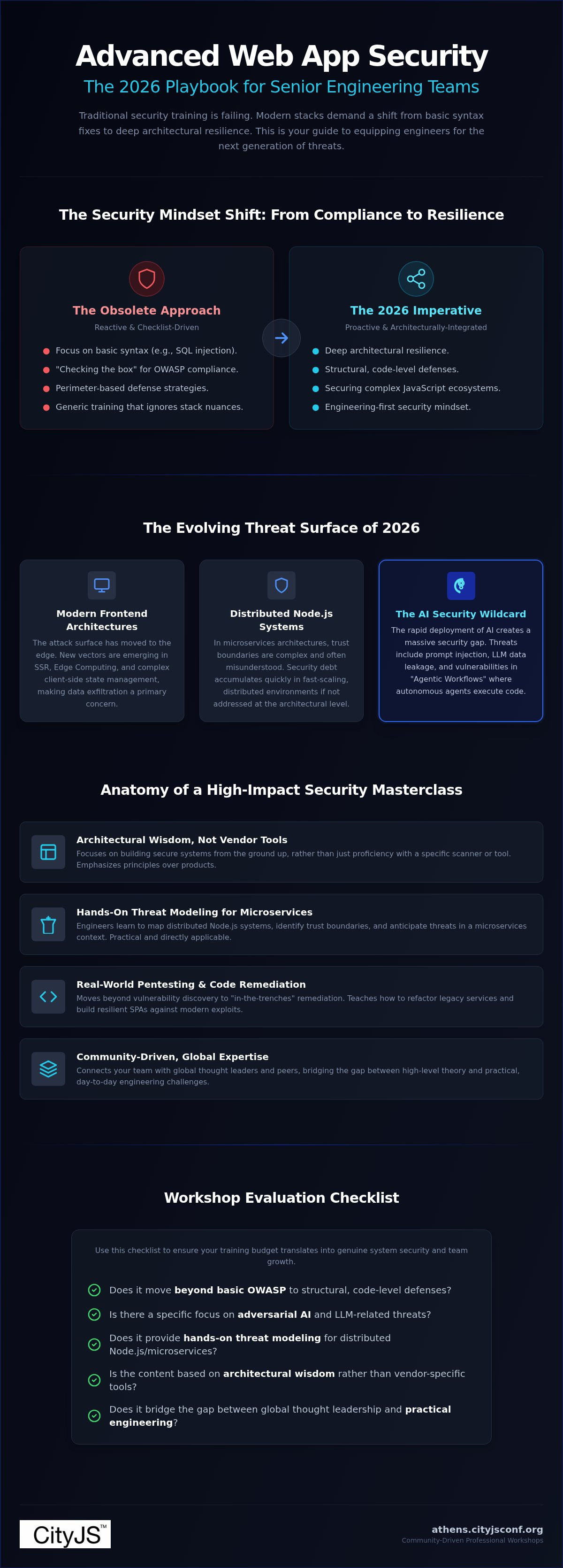
Most security training is a waste of engineering hours because it prioritizes basic syntax over architectural resilience. Your senior developers don't need a refresher on SQL injection; they need to understand how AI-integrated architectures and complex Next.js deployments change the attack surface. Selecting the right advanced web app security workshops is no longer about checking a compliance box. It is about equipping your lead engineers with the "in-the-trenches" expertise required to defend modern JavaScript ecosystems against sophisticated, 2026-specific threats.
You've likely felt the frustration of generic courses that fail to address the nuances of your specific stack. It's a common pain point for engineering leaders who value depth over introductory content. We promise to provide you with a clear evaluation checklist to identify high-impact training that moves beyond vendor-specific tools. You'll learn how to prioritize workshops that offer practical skills for Node.js and React architectures while facilitating elite networking opportunities with global thought leaders. This framework ensures your professional development budget translates into genuine system security and collective growth for your engineering team.
Key Takeaways
- Move beyond basic OWASP compliance by focusing on structural, code-level defenses and the emerging threat of adversarial AI in the 2026 landscape.
- Prioritize technical mastery in identity management and hands-on threat modeling specifically designed for distributed Node.js and microservices architectures.
- Evaluate advanced web app security workshops based on their ability to deliver architectural wisdom rather than just vendor-specific tool proficiency.
- Execute a rigorous readiness checklist to align your team’s training objectives with actual skill gaps in frontend, backend, or AI-integrated security.
- Bridge the gap between global thought leadership and practical engineering by choosing community-driven professional tracks that value real-world experience.
Beyond the OWASP Top 10: Why Senior Teams Need Advanced Security Training in 2026
Static checklists are dead. While the OWASP Top 10 remains a vital baseline, relying on it as a total security strategy in 2026 is like bringing a shield to a drone fight. Modern threats have moved past simple injection flaws. They now target the very structure of your system. Senior engineering teams must pivot from perimeter-based defense to structural, code-level resilience. Attending advanced web app security workshops is the only way to bridge this gap. These sessions move beyond the basics of application_security principles and dive into the complexities of securing highly distributed, real-time environments.
Security debt is the silent killer of fast-scaling engineering teams. In the rush to ship features, teams often ignore the subtle vulnerabilities inherent in their architectural choices. This isn't just about "fixing bugs"; it's about shifting to an engineering-first security mindset where defense is a compiler constraint rather than an afterthought. Basic certifications often focus on foundational concepts that are too entry-level for developers already managing high-performance Node.js architecture. You need depth, not definitions.
The Evolution of Threats in Modern Frontend Architecture
The move toward decentralized computing has fundamentally altered the attack surface. We've seen how modern frontend architecture trends, specifically the rise of Server-Side Rendering (SSR) and Edge Computing, introduce vectors that didn't exist five years ago. Client-side state management has become a prime target for data exfiltration. If your team isn't using advanced TypeScript patterns to enforce runtime security boundaries, they're leaving the door open. High-impact training must address these specific shifts in how we build and deploy the web.
AI Integration: The 2026 Security Wildcard
AI is no longer a feature; it's the core of the 2026 stack. This integration brings unprecedented risks like prompt injection and sensitive data leakage within LLM-powered workflows. We're now securing "Agentic Workflows" where autonomous agents have the power to execute code and modify databases. These agents require strict sandbox training and rigorous validation layers to prevent catastrophic failure. The AI Security Gap is the discrepancy between rapid AI deployment and security oversight. Without advanced web app security workshops that focus on adversarial AI, your team is essentially flying blind into the next generation of automated vulnerability exploitation.
Anatomy of a High-Impact Security Masterclass: Technical Pillars to Demand
High-performance teams don't settle for theoretical slides. They demand technical depth that mirrors their production environments. When evaluating advanced web app security workshops, look for a curriculum that prioritizes "in-the-trenches" remediation over simple vulnerability discovery. Anyone can run a scanner; few can refactor a legacy Node.js service to be resilient against modern exploitation. A true masterclass moves beyond the basics by aligning its exercises with the OWASP Application Security Verification Standard (ASVS), ensuring your team learns to build to an elite defensive benchmark. This rigor is what separates elite training from generic vendor pitches.
Security-first CI/CD isn't just about plugging in a tool. It's about integrating automated Static Application Security Testing (SAST) and Dynamic Application Security Testing (DAST) into the developer workflow without breaking momentum. Hands-on threat modeling for microservices is essential. Your engineers should be able to map out a distributed Node.js system and identify where the trust boundaries actually lie. Practical skills in real-world penetration testing for modern single-page applications (SPAs) are non-negotiable for senior roles. This pragmatic approach turns security from a bottleneck into a core feature of your delivery pipeline.
Advanced Identity and Access Management (IAM)
Basic login tutorials are for bootcamps. Senior engineers need to master multi-tenant security and fine-grained authorization logic. This often requires advanced TypeScript workshops that demonstrate how to implement type-safe security policies at the architectural level. Managing sessions in serverless or edge environments introduces unique challenges that standard training ignores. Your team should leave with a clear plan for identity management that scales without introducing latency or logic flaws. If you are looking to level up your team's expertise, exploring upcoming professional tracks is a logical next step.
Securing the Data Layer and API Surface
GraphQL has revolutionized data fetching, but it also opened the door to circular queries and depth-based denial of service. High-impact advanced web app security workshops must cover advanced CORS and CSP configurations to protect complex, multi-domain ecosystems. You need to know how to harden your API surface against automated tools that exploit loose schema definitions. API-first security is the bedrock of modern system design because it treats every endpoint as a potential entry point for an adversary. Mastering these technical pillars ensures your team is prepared for the reality of 2026 deployments.
Evaluating Workshop Formats: Vendor-Led vs. Community-Driven vs. Self-Paced
Choosing between training formats is a strategic decision that dictates your team's long-term defensive posture. Many vendor-led programs prioritize tool proficiency over genuine architectural wisdom. It's easy to teach someone to click a button in a specific security dashboard. It's much harder to teach them how to design a system that resists exploitation by default. For engineering leaders, advanced web app security workshops must offer more than a product demo. They need to provide framework-agnostic insights that remain relevant regardless of your specific cloud provider or tooling stack. This architectural focus is what builds true resilience.
Static online video modules often fail the engagement test for senior talent. A pre-recorded video can't answer a nuanced question about your team's specific microservices implementation. Live, expert-led sessions create a dynamic feedback loop that static content simply lacks. This is critical when navigating complex requirements like CISA guidance on preventing access control abuse. Real-time interaction ensures your team understands the underlying logic behind remediation. This prevents the "security-by-rote" habit that leads to overlooked edge cases and fragile codebases.
The ROI of In-Person Technical Training
In-person learning offers the "hallway track." This is where the most profound technical deep-dives happen. You aren't just watching a screen; you're debating architectural patterns with global speakers and peers. This environment is where senior developer career growth is truly accelerated. High-prestige summits provide access to mentors like Kyle Simpson, whose real-world experience outweighs any recorded tutorial. Intensive, multi-day workshops build team cohesion and establish shared security standards that survive long after the event ends. The shared memory of solving a complex exploit together creates a lasting defensive culture within your organization.
Community-Led vs. Corporate Training Models
Corporate models are often slow to adapt to the latest framework vulnerabilities. Community-led summits possess the agility to address 2026-specific threats as they emerge in the wild. They foster a national network of security-conscious leaders who face identical infrastructure challenges. Balancing high-level professional tracks with free community workshops allows for broader team impact without sacrificing technical depth. This hybrid approach ensures that while your leads get elite, "in-the-trenches" training, the entire ecosystem grows together. You're not just buying a seat; you're joining a collective of practitioners committed to securing the national tech landscape. This peer-to-peer networking is a value add that vendor-specific training can't replicate. It turns advanced web app security workshops into a collaborative defense strategy rather than a solitary learning exercise.
The Engineering Readiness Checklist: Preparing Your Team for Advanced Security Training
High-impact results from advanced web app security workshops don't happen by accident. They are the result of deliberate alignment between training content and your current engineering roadmap. Before committing your senior talent to a masterclass, you must audit your current skill gaps. Does your team need to harden a distributed Node.js backend, or are they facing unique challenges with AI-integrated data exfiltration? Defining whether you need "exploit awareness" or "defensive implementation" skills is the first step toward ensuring the training translates into production-ready code.
Defining Your Team's Security Persona
Is your team "Offensive-Curious" or "Defensive-Driven"? The former prioritizes pentesting and vulnerability discovery, while the latter focuses on building structural architecture that is secure by design. You must match the workshop depth to the complexity of your production stack to avoid wasting time on irrelevant concepts. Many executives leverage engineering leadership networking to find vetted trainers who have experience with high-scale JavaScript environments. This peer-to-peer vetting filters out the noise and identifies workshops that offer genuine "in-the-trenches" value.
Logistics and Budgeting for National Summits
Calculating the ROI of professional development is straightforward when you compare the cost of Early Bird tickets to the catastrophic price of a data breach. National engineering summits offer group ticket options that allow you to upskill a full squad simultaneously, creating a unified defensive culture. This collective experience is far more effective than sending developers to isolated, individual courses. A ratio of one senior mentor for every four developers during a hands-on session typically yields the highest rate of long-term knowledge retention. To secure the best value for your team, you should view our professional workshop packages before the next summit cycle begins.
Elevating Your Security Posture with CityJS Professional Workshops
Building a high-performance, secure web application is no longer a solo endeavor. It requires a collective commitment to excellence that transcends simple coding. Our advanced web app security workshops at CityJS are designed to foster this national movement of engineers. We don't just teach tools; we cultivate a security-first engineering mindset. This unique blend of JavaScript mastery and production-grade safety is what allows your team to innovate with confidence. By joining our professional tracks, you're accessing a curated ecosystem of knowledge that bridges the gap between rapid AI adoption and architectural stability.
The 2026 landscape demands more than just awareness; it requires mastery. CityJS acts as a bridge between global thought leaders and the local professional scene, ensuring your team isn't just following trends but setting them. We focus on the practical, real-world application of security principles within modern Node.js and React ecosystems. This ensures that every hour spent in our workshops translates directly into a more resilient production environment. Your senior developers deserve training that respects their expertise and challenges their architectural assumptions.
Curated Learning from Global Industry Leaders
Generic certifications often lack the nuance of real-world production environments. Learning from "in-the-trenches" experts provides a level of pragmatism that abstract theory can't match. At CityJS, we prioritize human connection and shared professional journeys. Senior engineers benefit most from spontaneous technical deep-dives and the collective wisdom of their peers. Our workshops are intentionally high-impact and low-noise. We filter out the fluff to provide only the most relevant information for senior practitioners. This focus on depth ensures your team leaves with actionable skills rather than just a certificate on a wall. It is about building memories and a professional network that lasts a lifetime.
Next Steps: Securing Your Team’s Participation
Securing your team's participation starts with a clear alignment of goals. Review our 2026 workshop schedule to identify the specific AI and security-focused tracks that match your current roadmap. Justifying the investment to stakeholders is simple when using our ROI framework. The cost of a professional workshop is a fraction of the expense associated with a single data breach or a failed architectural migration. It's an essential investment in your team's career growth and your organization's resilience. The window for participation is narrowing, so taking decisive action now is critical for your squad's development. Secure your team's professional workshop seats for CityJS Athens 2026 to ensure they have the tools to defend the modern web.
Secure Your Architectural Legacy
The shift from perimeter defense to structural resilience is the defining challenge for engineering leaders this year. You've seen why generic training fails senior talent and how 2026-specific threats like adversarial AI demand a deeper, more technical approach. Investing in advanced web app security workshops ensures your team isn't just reacting to threats but building systems that are resilient by design. By prioritizing architectural wisdom over tool proficiency, you're securing your organization's future and your team's professional growth.
CityJS Athens offers a unique opportunity to learn from world-class engineers through deep-dive sessions on AI and modern JS security. As part of our prestigious global network, these workshops provide the "in-the-trenches" experience that static courses lack. Don't let your squad fall behind the curve of rapid innovation. Register your team for advanced professional workshops at CityJS Athens 2026 today. We're excited to help your team lead the next wave of secure, high-performance engineering.
Frequently Asked Questions
Are advanced web app security workshops worth it for senior developers?
Advanced training is absolutely worth the investment for senior developers who have outgrown generic checklists. These sessions provide the architectural depth required to defend complex, modern stacks in 2026. While junior talent might focus on syntax, seniors benefit from "in-the-trenches" experience that reframes security as a structural constraint. This level of mastery ensures your leads can design resilient systems that resist exploitation by default.
What is the difference between a security certification and a professional workshop?
Certifications typically validate foundational literacy and compliance standards through standardized testing. Professional workshops focus on hands-on remediation and architectural wisdom gained from real-world exploitation scenarios. While a certification might prove you understand a definition, a workshop ensures you can refactor a vulnerable microservice. For senior teams, the ability to implement defensive patterns in production is far more valuable than a digital badge.
How do I evaluate the ROI of a technical security masterclass?
ROI should be measured by the reduction in security debt and the increased speed of implementing new defensive protocols across your squad. Compare the cost of professional workshop tickets against the documented average expense of a data breach in your industry. Beyond the balance sheet, the long-term value lies in team cohesion and the establishment of shared security standards that survive long after the event ends.
Does my team need to know specific security tools before attending an advanced workshop?
Most high-impact training focuses on patterns and principles rather than specific vendor dashboards. Your team needs a senior-level understanding of JavaScript and TypeScript architecture rather than a specific tool certification. Senior developers should prioritize advanced web app security workshops that teach them how to identify structural flaws that tools might miss. Principles-based training ensures your defensive strategy remains relevant even as your tooling stack evolves.
How does AI integration change the requirements for web security training in 2026?
AI integration introduces unprecedented risks such as prompt injection and data leakage within autonomous agentic workflows. Training in 2026 must address the discrepancy between rapid AI deployment and security oversight. Your team needs to master sandboxing techniques and strict validation layers for LLM-powered applications. This shift moves security from the network perimeter directly into the logic of your AI-integrated code.
What are the benefits of attending an in-person security workshop over an online course?
In-person sessions facilitate the "hallway track" where the most profound technical deep-dives occur between global experts and peers. These environments offer real-time feedback and spontaneous networking opportunities that online courses simply cannot replicate. For senior engineers, the value of human connection and shared professional journeys is a major catalyst for career growth. It turns a solitary learning exercise into a collaborative defense strategy.
Can free community workshops provide enough depth for professional engineering teams?
Free sessions are vital for grassroots community growth and establishing a baseline of security awareness. However, advanced web app security workshops found in professional tracks provide the depth and complexity required for engineering leads. Professional workshops offer direct access to world-renowned mentors and focus on high-performance, production-grade safety. They are designed for practitioners who need to move beyond introductory content and solve "in-the-trenches" architectural challenges.
How do I choose between a vendor-specific and a framework-agnostic security workshop?
Vendor-led training often prioritizes product proficiency over genuine architectural wisdom. If you want your team to master a specific tool, go with the vendor; if you want them to build resilient systems, choose framework-agnostic training. Framework-agnostic workshops provide insights that remain relevant regardless of your specific cloud provider or stack. This approach builds a more versatile and durable defensive posture for your entire engineering organization.


