

The industry consensus that Python owns the AI orchestration layer is officially obsolete. In 2026, the high latency and synchronization overhead of Python-centric loops have pushed senior engineers back toward the event-driven efficiency of the JavaScript runtime. Mastering the art of building AI agents with JavaScript is no longer a niche skill; it's a performance requirement for real-time, production-grade systems.
You've likely felt the friction of porting fragmented documentation or fighting over-abstracted frameworks that hide the actual logic of the ReAct pattern. We agree that the brittleness of autonomous agents in production often stems from a lack of granular control over the execution loop. This guide provides the pragmatic, in-the-trenches blueprint you need to build from scratch or with minimal libraries. We'll strip away the magic to implement sophisticated tool-calling and manage stateful memory. You'll move from theoretical concepts to deploying autonomous workflows that are actually reliable, scalable, and fast.
Key Takeaways
- Understand why 2026 marks the shift from Python to JavaScript for low-latency agentic orchestration in high-concurrency environments.
- Implement the ReAct pattern to bridge the gap between abstract LLM reasoning and concrete system actions.
- Master the technical nuances of building AI agents with JavaScript using native ESM, TypeScript, and robust error-handling wrappers.
- Evaluate enterprise-grade frameworks like LangChain.js against streamlined tools like the Vercel AI SDK to minimize over-abstraction.
- Transition your professional role from a traditional developer to an agentic architect capable of managing complex, stateful AI memory.
The Shift to Agentic Workflows in the JavaScript Ecosystem
Software development is undergoing its most radical transformation since the move to the cloud. We've moved past deterministic systems where every input has a predictable, hard-coded output. We're now entering the era of the AI agent. These systems don't just follow a script; they reason, plan, and execute tasks autonomously. In national engineering circles, the myth persists that Python is the only viable language for this frontier. That assumption is officially dated.
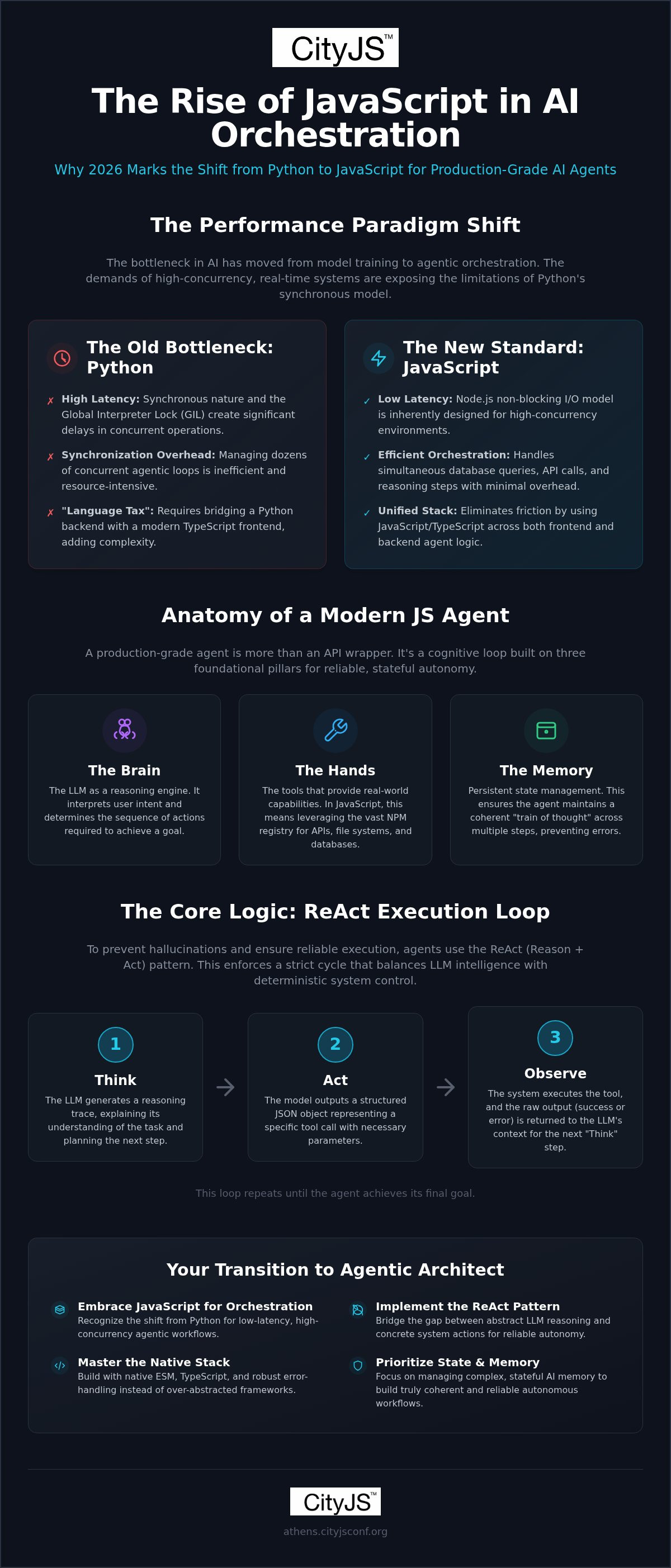
By 2026, the bottleneck in AI development has shifted from training models to orchestrating complex, multi-step loops. This is where building AI agents with JavaScript provides a decisive edge. Python's synchronous nature and Global Interpreter Lock (GIL) create significant latency when managing dozens of concurrent agentic loops. Node.js, built on the V8 engine, utilizes a non-blocking I/O model that is inherently designed for high-concurrency environments. When your agent needs to query a database, call an external API, and process a reasoning step simultaneously, JavaScript handles the orchestration with far less overhead.
Why JavaScript for AI Agents?
JavaScript is the native language of the web's interface. Choosing it for agentic workflows eliminates the "language tax" of bridging a Python backend with a modern TypeScript frontend. It's about architectural pragmatism. Senior engineers favor this stack for three primary reasons:
- Infrastructure Synergy: Agents live where the users are. JavaScript allows for seamless integration with existing React, Vue, or Next.js codebases.
- Real-time Capabilities: Agents must communicate their "thoughts" and actions instantly. JavaScript's native support for WebSockets and Server-Sent Events makes streaming agentic reasoning traces effortless.
- Type-Safe Reasoning: The TypeScript ecosystem provides the strict schemas necessary for tool outputs and agent states. This drastically reduces the brittleness often found in autonomous systems.
Core Components of a Modern AI Agent
Effective building AI agents with JavaScript requires a clear architectural separation of concerns. You aren't just writing a wrapper for an API; you're designing a cognitive loop. Every production-grade agent requires three foundational pillars:
The Brain: This is the LLM acting as a reasoning engine rather than a simple text generator. It interprets intent and selects the sequence of actions.
The Hands: These are the tools. In the JS ecosystem, this means leveraging the massive npm registry to give your agent power over file systems, database clusters, and third-party SaaS platforms.
The Memory: Agents require persistent state. Context management ensures the agent maintains a coherent "train of thought" across sequential execution steps, preventing the loop from collapsing into recursive errors.
Designing the Architecture of an Autonomous JavaScript Agent
An AI agent is a system that uses an LLM to choose a sequence of actions to reach a goal. Unlike traditional scripts, these agentic workflows operate with a degree of situational awareness. They don't just execute; they decide. When building AI agents with JavaScript, the architecture must prioritize state management and deterministic control over non-deterministic outputs. The ReAct pattern is the standard for 2026 agentic logic. It provides the necessary framework to balance raw model intelligence with reliable system execution.
The Reasoning Loop: Think, Act, Observe
The core of any autonomous system is the execution loop. To prevent the model from hallucinating or losing track of its objective, we structure system prompts to enforce a strict Think-Act-Observe cycle. You aren't just asking for an answer. You're demanding a reasoning trace. This forces the model to document its internal logic before committing to a tool call.
- Think: The model generates a reasoning trace, explaining its current understanding of the task.
- Act: The model outputs a structured JSON object representing a specific tool call.
- Observe: The system executes the code and returns the raw output back into the context window.
Parsing these outputs requires a robust parser that handles common LLM formatting quirks, such as unexpected markdown blocks or trailing commas. Mastering this loop is often the focus of our hands-on professional workshops, where we dive into real-world edge cases and performance tuning.
Tool Definition and Schema Validation
An agent is only as capable as its interface with the real world. In the JavaScript ecosystem, we use Zod schemas to define tool parameters. This ensures runtime type safety and provides the LLM with clear, machine-readable descriptions of what each tool expects. Clear descriptions are non-negotiable. If a tool's purpose is ambiguous, the agent will select it incorrectly or provide malformed arguments.
Error handling is the final piece of the architectural puzzle. When building AI agents with JavaScript, tool failures must be treated as "Observations" rather than system crashes. If a database query fails, the error message should be fed back to the model. This allows the agent to self-correct, perhaps by trying a different search term or correcting a syntax error in its generated query. This resilience is what separates a basic demo from a production-grade autonomous system.
Choosing Your Stack: Frameworks vs. Native Implementation
Selecting your technical stack is the first major architectural decision you'll face. By 2026, the choice isn't just about syntax; it's about where you want your complexity to live. While many developers default to the most mentioned library on GitHub, senior engineers evaluate the trade-offs between speed of delivery and long-term maintainability. Building AI agents with JavaScript allows for a spectrum of implementations, from heavy enterprise frameworks to lean, native loops.
LangChain.js remains the dominant player for enterprise applications. It provides a massive library of pre-built integrations for vector stores, document loaders, and memory buffers. However, this comes at the cost of significant abstraction. If you're building a complex, multi-agent system where standardization across a large team is paramount, LangChain's structured patterns are invaluable. In contrast, the Vercel AI SDK has emerged as the preferred choice for frontend-heavy agents. It excels at managing the streaming state between the server and the UI, making it ideal for real-time chat interfaces and generative dashboards.
When to Reach for a Framework
Frameworks are essentially productivity accelerators. They allow for rapid prototyping by providing "off-the-shelf" solutions for common agentic hurdles. You should consider a framework when your project requires:
- Standardization: Providing a shared vocabulary and structure for engineering teams, which makes code reviews and onboarding more efficient.
- Tool Ecosystem: Gaining immediate access to community-driven observability tools and tracing integrations like LangSmith or Helicone.
- Pre-built Logic: Implementing complex patterns like self-querying or hierarchical agent routing without writing the orchestration logic from scratch.
The Case for Building Without Abstractions
Despite the convenience of frameworks, there is a growing movement toward native implementation. When building AI agents with JavaScript from scratch, you eliminate the "black box" problem. Debugging an agentic loop that has failed in production is significantly easier when you aren't digging through ten layers of framework middleware. You see every prompt, every retry, and every byte of data passing through the system.
Building without abstractions also allows for extreme performance optimization. You can minimize your bundle size and reduce execution latency by only including the specific logic your agent requires. This "in-the-trenches" approach gives you granular control over memory management and prompt construction. Whether you're calling OpenAI's GPT-4o, Anthropic's Claude 3.5, or running local models via Ollama to keep data on-premises, a native implementation ensures your architecture remains flexible. You can swap providers or modify the reasoning loop without fighting against a framework's opinionated design.
Implementation Guide: Building a Production-Ready Agent
Transitioning from a local prototype to a production environment requires more than just a clever prompt. It demands a rigorous approach to system stability, security, and cost management. Production-grade observability is the key to agent reliability. Without a clear window into every reasoning step, you're flying blind when an autonomous loop consumes thousands of tokens on a recursive error. Building AI agents with JavaScript in a professional context means architecting for failure as much as for success.
Setting Up the Node.js/TypeScript Environment
We start with a modern ESM foundation. Avoid CommonJS to ensure full compatibility with the latest AI libraries and native top-level await features. Your core dependency stack should remain lean and purposeful. Use the OpenAI SDK for model interaction, Zod for strict runtime schema validation, and Dotenv for secure secret management. Structure your project by separating concerns; prompts should live in their own registry, while tools are defined as modular, testable units. For a deep dive into the underlying server setup, see our high-performance Node.js architecture guide for base setup.
Implementing the Execution Loop
The execution loop is the heart of the agent, yet it's where most implementations fail. A production-ready loop must include hard recursion limits to prevent infinite cycles that drain API budgets. Wrap your reasoning steps in a robust error-handling layer that specifically catches rate limits, context window overflows, and malformed JSON. We recommend using the AI integration for web developers checklist to ensure your implementation meets strict security standards. Testing behavior with edge-case prompts is non-negotiable. Simulate tool failures to verify if your agent can gracefully self-correct or if it collapses into a repetitive loop.
Scaling toward multi-agent systems involves managing stateful memory across distributed environments. Use Redis for rapid, short-term session context and vector databases for long-term knowledge retrieval. As you move from 'builders' to 'orchestrators,' the complexity of agent handoffs and token cost management becomes your primary challenge. You can master these high-stakes implementation strategies at our professional workshops, where we build and stress-test real-world agentic systems together. Practical experience with these patterns is the only way to secure your role as a leader in the 2026 engineering landscape.
Scaling AI Expertise within the National Engineering Community
The technical blueprint for building AI agents with JavaScript is only the first step toward senior-level mastery. In 2026, the role of the engineer has fundamentally shifted. You're no longer just a 'builder' of isolated functions or static endpoints. You've become an orchestrator of cognitive systems, responsible for the reliability and safety of autonomous workflows. This transition requires a different mental model, one that prioritizes system resilience and architectural foresight over simple syntax.
Scaling this expertise within the national engineering community isn't something that happens through a screen. It demands a high-density environment where failures are shared as openly as successes. We've seen that the most significant breakthroughs in agentic logic come from collective troubleshooting. Leveraging national networking events allows you to see how other senior architects are handling the same latency and memory challenges you face in your daily sprints. It's about building a shared professional memory that benefits the entire ecosystem.
Hands-on Training and Senior Networking
Online documentation can only take you so far when you're fighting high latency in complex agentic loops. Technical mastery is forged through peer-to-peer code reviews and intensive, face-to-face collaboration. Validating your agentic architecture with global leaders like Kyle Simpson or Tejas Kumar provides a level of professional security that a tutorial simply cannot offer. These interactions allow you to stress-test your ideas against the world's most sophisticated implementation standards before they hit production.
Bridging the Gap from Code to Production
CityJS Athens provides the essential bridge between theoretical knowledge and real-world implementation. Our professional workshops are designed specifically for practitioners who value depth over introductory content. This is the fastest path to mastering token cost management, stateful memory optimization, and the prevention of the brittleness that plagues amateur autonomous agents. It's about securing your spot in the next professional development cycle to ensure you stay ahead of the curve. Secure your CityJS Athens tickets to join the 2026 AI masterclasses and solidify your expertise in building AI agents with JavaScript.
Mastering the Agentic Future
The transition from deterministic code to autonomous systems is the defining challenge for senior engineers this decade. We've explored how the event-driven nature of Node.js provides a significant performance advantage when orchestrating complex loops. By moving beyond "black box" frameworks and implementing the ReAct pattern directly, you gain the granular control required for production-grade reliability. Mastering the technical nuances of building AI agents with JavaScript is no longer optional for those leading high-impact engineering teams. It's the standard for 2026.
To move from theory to "in-the-trenches" implementation, you need more than a guide. You need the collective experience of the national engineering community. Register for CityJS Athens 2026 and Join Our AI Workshops to experience expert-led sessions by industry pioneers like Kyle Simpson and Tejas Kumar. Join 500+ technical leaders for three days of intensive, hands-on workshops designed specifically for senior engineers. This is your opportunity to validate your architecture and share implementation failures in a high-prestige, community-oriented setting. Let's build the future of autonomous systems together.
Frequently Asked Questions
Can I build AI agents with JavaScript instead of Python?
Yes, you can. JavaScript's non-blocking I/O is superior for handling the high concurrency required by agentic loops. While Python has a larger data science library ecosystem, the orchestration layer in 2026 is increasingly shifting toward Node.js and TypeScript. This shift allows for better integration with existing web infrastructure and real-time streaming capabilities. Senior engineers often find that building AI agents with JavaScript reduces the "language tax" between frontend and backend.
What is the best JavaScript framework for building AI agents in 2026?
The best choice depends on your specific use case and architectural goals. LangChain.js remains the standard for complex, enterprise-grade multi-agent systems due to its vast integration library. For frontend-centric or edge-deployed agents, the Vercel AI SDK is the more streamlined option. Many senior engineers now prefer building AI agents with JavaScript using native patterns to avoid the overhead and "magic" of large, opinionated frameworks that can be difficult to debug.
How do I handle long-running agentic tasks in a Node.js environment?
Offload agentic loops to background worker threads or dedicated microservices to keep the main event loop responsive. Use persistent message queues like BullMQ or Redis to manage task states and handle retries gracefully. This architecture prevents a single complex reasoning chain from blocking user-facing operations. It ensures your system remains stable under heavy load. Pragmatic state management is the difference between a fragile demo and a production-grade autonomous system.
Is it safe to give an AI agent access to my production APIs?
Safety depends entirely on the implementation of strict sandbox environments and narrow scoping. Never give an agent full administrative credentials; instead, use granular OAuth scopes and read-only access where possible. Implementing a "human-in-the-loop" approval step for sensitive write operations is a critical best practice for production-grade agentic workflows. You must treat the agent as an untrusted user and validate every action it attempts to perform against your existing security policies.
What are the hardware requirements for running local JS agents?
Local execution requirements vary based on whether you're running the LLM locally or just the JS orchestration logic. For local model execution via tools like Ollama, you'll need at least 16GB of unified memory and a modern GPU. If you're only building AI agents with JavaScript to call cloud APIs, the hardware requirements are minimal. Any standard Node.js server can handle the orchestration logic without significant resource overhead or specialized AI accelerators.
How much does it cost to run autonomous agents in production?
Costs are primarily driven by token consumption and the number of reasoning steps per task. A single autonomous loop can cost anywhere from a fraction of a cent to several dollars. This depends on the model's complexity and the volume of context retrieved. It's essential to monitor token usage in real-time and implement strict budget caps. This prevents unexpected billing spikes during recursive loops that fail to find a solution or get stuck.
How do I prevent my AI agent from getting stuck in an infinite loop?
Implement a hard "max iterations" limit within your execution loop to force a termination after a set number of steps. You should also monitor for repetitive reasoning patterns where the agent produces identical outputs multiple times. If the limit is reached without a resolution, the system should trigger a fallback mechanism. Requesting human intervention is often the safest way to break a cycle that the model cannot solve autonomously.


