
The era of the single-threaded Node.js developer is officially over. As we move through 2026, simply wrapping an API around a database no longer qualifies as elite engineering. With Node.js 20 reaching its end-of-life in April and the recent high-severity security patches for versions 22, 24, and 26, the stakes for system stability and performance have never been higher.
You've likely hit the ceiling of the standard event loop. You've battled CPU-intensive bottlenecks and watched memory leaks degrade long-running processes during peak traffic in the Greek market. It's frustrating to see microservices struggle under erratic loads when you know the underlying engine is capable of more. We believe that real-world experience beats abstract theory every time. This article promises to help you master high-performance Node.js architecture by diving deep into internal optimizations and multi-threaded orchestration required for elite systems.
We'll provide a clear roadmap for engineering scalable systems that thrive under pressure. You'll learn actionable patterns for AI-integrated performance tuning and how to navigate the upcoming shift to a single annual release cycle starting with Node 27 this October. It's time to transition from basic patterns to building resilient, production-grade systems that lead the industry.
Key Takeaways
- Transition from simple non-blocking I/O to complex system orchestration to meet the rigorous architectural standards required in 2026.
- Deepen your technical edge by deconstructing V8 optimization pipelines and Libuv internals to build a truly high-performance Node.js architecture.
- Implement Hexagonal Architecture to decouple core business logic from volatile I/O, ensuring your systems scale seamlessly under erratic loads.
- Leverage WebAssembly for near-native performance in critical paths while mastering multi-layered caching strategies across Redis and CDN levels.
- Evolve your leadership role within the Greek tech scene by prioritizing deep-dive professional workshops over basic documentation.
The Evolution of High-Performance Node.js Architecture in 2026
The transition from simple non-blocking I/O to sophisticated system orchestration is the defining shift of this year. We've moved past the days when Node was just a "fast" way to build APIs. In 2026, the "JavaScript Everywhere" paradigm has matured into a standard for enterprise-grade infrastructure. It's no longer about the convenience of using one language. It's about engineering rigor. High-performance Node.js architecture now requires a deep understanding of how the runtime interacts with modern hardware. Specifically, the rise of high-core-count ARM processors in European data centers has changed how we think about execution efficiency and vertical scaling.
Performance isn't a luxury. It's a business moat. In the Greek tech ecosystem, where efficiency directly impacts competitiveness and operational margins, optimizing your stack is a financial imperative. Every millisecond shaved off a request translates to lower compute overhead and reduced cloud billing in Euro. If your architecture isn't lean, you're essentially burning capital on unoptimized cycles. We've moved into an era where "good enough" performance is a liability that senior leadership can no longer ignore.
The 2026 Performance Benchmark
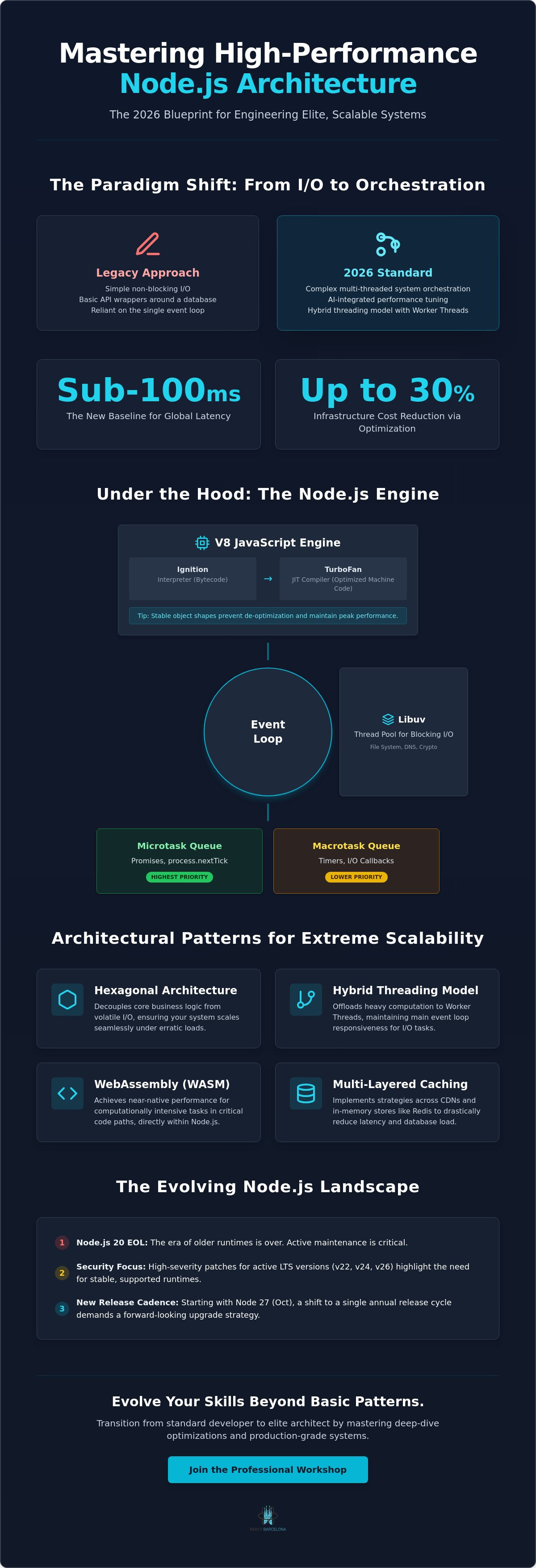
Sub-100ms global latency is now the baseline for production-grade systems. This shift is driven by massive updates to the V8 engine's JIT compilation pipelines, which have radically improved execution speed for complex logic. A well-designed high-performance Node.js architecture doesn't just handle traffic; it minimizes the resource footprint. By optimizing for the latest runtime features, senior engineers are slashing infrastructure costs by up to 30% compared to legacy patterns. In a market like Greece, where scaling a startup often means managing tight budgets, these efficiencies are the difference between growth and stagnation.
Beyond the Single Thread: The New Reality
The myth that Node.js is only for simple I/O tasks has finally been dismantled. Elite engineering teams now utilize a hybrid threading model. They offload heavy computation to Worker Threads while maintaining the responsiveness of the main event loop. This requires a shift in perspective. You can't just write JavaScript. You have to understand the C++ layers and how Libuv manages the thread pool. Mastery of these internals separates the senior architects from the hobbyists. While a basic grasp of Node.js architecture is essential, 2026 requires you to orchestrate these components with surgical precision. This isn't just about code; it's about building systems that are resilient, observable, and exceptionally fast under pressure.
Deconstructing Internals: V8, Libuv, and the Multi-Threaded Reality
Libuv is the multi-platform support library for asynchronous I/O. While the JavaScript execution remains on a single thread, the reality of a high-performance Node.js architecture relies on how efficiently the runtime offloads blocking tasks. When your application performs file system operations or DNS lookups, it utilizes the Libuv thread pool. In 2026, understanding the handoff between the main event loop and these background threads is what separates senior architects from standard developers. If you don't account for thread pool size limits, your high-concurrency system will face silent bottlenecks that no amount of vertical scaling can fix.
The V8 engine's Just-In-Time (JIT) compilation has reached new levels of sophistication. It uses the Ignition interpreter to generate bytecode while the TurboFan compiler optimizes hot code paths into machine code. This optimization relies on stable object shapes. If your code frequently changes the structure of objects at runtime, you trigger de-optimizations that kill performance. Aligning your coding patterns with Node.js project architecture best practices ensures that V8 can maintain peak execution speeds without falling back to slower interpreted code.
Task scheduling has also evolved. The 2026 runtime behavior prioritizes the Microtask queue over the Macrotask queue with surgical precision. Promises and process.nextTick callbacks are cleared immediately after the current operation, before the loop moves to I/O or timers. Mismanaging this flow leads to event loop starvation. This happens when a flood of microtasks prevents the loop from ever reaching the macrotask phase; effectively freezing your I/O. Mastering this balance is essential for building responsive, low-latency systems.
Orchestrating Worker Threads and Atomics
CPU-intensive logic shouldn't live on the main thread. By implementing worker_threads, you can run heavy data processing or encryption in parallel. To achieve elite speeds, use SharedArrayBuffer and Atomics for inter-thread communication. This allows threads to share memory directly rather than copying data through expensive message serialization. It's a high-stakes pattern that requires disciplined memory management to prevent the overhead of spawning too many workers. If you're looking to implement these patterns in live environments, our professional workshops provide the practical, in-the-trenches training you need.
Memory Internals and Garbage Collection Tuning
Efficiency starts in the heap. V8 manages memory through a generational strategy: New Space for young objects and Old Space for long-lived data. In memory-intensive 2026 environments, you must use advanced flags like --max-old-space-size to prevent premature crashes. Fine-tuning garbage collection using flags such as --scavenge-task-trigger can reduce pause times in high-throughput apps. Identifying memory leaks is now faster with modern diagnostic tools, but the best strategy remains a high-performance Node.js architecture that prioritizes object pooling and avoids global state pollution.
Architectural Patterns for Extreme Scalability
Choosing the right structural foundation is where many projects fail before the first line of code is written. In 2026, building a high-performance Node.js architecture isn't about following trends; it's about matching the pattern to the specific workload. Monoliths aren't dead. For many Greek enterprises, a well-structured modular monolith provides lower latency and reduced operational complexity compared to fragmented microservices. However, when global scale is the goal, the move to Event-Driven Architecture (EDA) becomes non-negotiable. EDA allows your system to remain elastic, handling traffic spikes without overwhelming core database resources.
Hexagonal Architecture, often called "Ports and Adapters," has become the gold standard for senior engineers this year. By decoupling core business logic from volatile I/O like databases and external APIs, you ensure that your system remains testable and performant. This separation allows you to swap out a database driver or an external service provider without touching the core logic. It's a disciplined approach that prevents technical debt from slowing down your execution speed. In a high-stakes production environment, this isolation is your best defense against cascading failures.
Strategic offloading is equally vital. Don't let Node.js handle SSL termination or static file serving. Use an API Gateway or a reverse proxy like Nginx or Envoy to manage these tasks. This keeps the event loop free for what it does best: orchestrating application logic and managing asynchronous flows. By moving heavy lifting to the infrastructure layer, you maximize the throughput of every Euro spent on compute resources.
Microservices and the Performance Tax
Microservices offer agility but come with a "performance tax" in the form of network latency. To mitigate this, senior teams are moving away from REST for internal communication. They use gRPC or Avro to achieve faster serialization and lower overhead. When real-time synchronization isn't required, message brokers like RabbitMQ or Kafka allow for asynchronous scaling. This ensures that a bottleneck in one service doesn't bring down your entire high-performance Node.js architecture.
Edge Computing and Node.js Runtimes
The rise of lightweight Node-compatible runtimes has pushed logic closer to the user. Architecting for the edge requires a shift in how we handle "Cold Starts" in serverless environments. You must keep your deployment bundles lean and minimize heavy dependencies. Moving validation, caching, and simple routing from the core backend to the network edge reduces global latency and provides a snappier experience for the end user. It's about placing the right logic in the right place.
Critical Performance Optimization Strategies for Senior Engineers
Standard optimizations like async/await and basic indexing are now considered table stakes. In 2026, building a high-performance Node.js architecture requires a shift toward near-native execution speeds and autonomous system management. We've moved beyond reactive scaling. The elite engineering teams in the Greek market are now implementing predictive models that anticipate traffic surges before they hit the load balancer. This prevents the costly "warm-up" period where performance dips as new instances spin up. If you're still relying on basic CPU threshold triggers, you're already behind the curve.
Database efficiency has also evolved. While connection pooling remains vital, query pipelining in Node.js allows you to send multiple requests to the database without waiting for the previous response. This significantly reduces the time spent in I/O wait states. When combined with a multi-layered caching strategy, you create a system that is virtually immune to database bottlenecks. You should be layering your data: keep frequently accessed objects in local in-memory stores, use Redis for shared state across clusters, and push static or semi-static content to the CDN edge.
WebAssembly (WASM) Integration
JavaScript is fast, but it has limits. For "hot paths" like complex cryptography, image manipulation, or heavy mathematical simulations, WebAssembly is the solution. You can compile Rust or C++ into WASM modules that Node.js consumes with minimal overhead. Performance benchmarks show that WASM consistently beats highly optimized V8 code in compute-heavy scenarios by avoiding the overhead of garbage collection and dynamic typing. Identifying these critical paths and offloading them to WASM is a hallmark of a high-performance Node.js architecture.
Observability and Real-Time Profiling
You can't optimize what you can't see. Moving beyond simple logging, senior engineers must implement distributed tracing with OpenTelemetry. This provides a granular view of how requests flow through your services, exposing hidden latencies. Use Flame Graphs to visualize the event loop. These charts allow you to identify exactly which function is blocking the loop, even if it's buried deep in a third-party dependency. To maintain these standards, you should integrate automated performance regression testing into your CI/CD pipeline to catch degradations before they reach production.
Mastering these advanced strategies requires more than just reading a blog post; it demands hands-on experience with the latest tools and patterns. If you want to refine these skills alongside global experts, consider securing your spot at our upcoming professional workshops in Athens to dive deeper into these architectural challenges.
Mastering Production-Grade Node.js Systems
Code is only half the battle. To maintain a high-performance Node.js architecture, you must invest heavily in the people who build and maintain it. Reading the official documentation is no longer enough to stay ahead of the curve in 2026. Documentation tells you what a feature does; it rarely explains how that feature behaves when your system is processing thousands of concurrent requests from users across Greece. Real-world engineering requires a transition from understanding simple syntax to mastering complex system orchestration and hidden failure modes.
The Value of Expert-Led Technical Training
Online tutorials often gloss over the complex edge cases that crash production systems. Deep-dive workshops provide a return on investment that passive learning simply cannot match. When you learn from global thought leaders who architect systems for millions of users, you gain insights into architectural peer review and advanced debugging that aren't found in a search engine. Networking with other senior engineers in the Greek ecosystem serves as a powerful tool for knowledge sharing. It's about collective growth and establishing a national standard for technical excellence.
Securing Your Place in the Engineering Vanguard
Transitioning from a senior developer to a true system architect requires specialized mastery. High-level conferences play a critical role in shaping the technology landscape of the country. They act as an elite filter, removing the noise and providing only the most relevant, high-impact information for practitioners. If you're ready to move beyond the basics and tackle the most demanding challenges in high-performance Node.js architecture, the time to act is now. Join industry leaders for advanced Node.js performance workshops at CityJS Athens 2026 to secure your place in the engineering vanguard and elevate your career to the next level.
Engineering Your Competitive Edge for 2026
Engineering excellence in 2026 isn't defined by the code you write today. It's defined by the systems that survive tomorrow's scale. We've explored the critical shift from simple event-loop patterns to the multi-threaded reality of Worker Threads and WASM offloading. You now understand why a high-performance Node.js architecture requires both deep internal knowledge of V8 and a commitment to rigorous architectural patterns like Hexagonal design. These aren't just technical choices; they're the foundation of a resilient business moat.
Abstract theory can only take you so far. To truly lead the Greek tech ecosystem, you need "in-the-trenches" experience. CityJS Athens 2026 is where global thought leaders and local innovators meet. Featuring expert speakers like Kyle Simpson and Tejas Kumar, our event focuses on real-world engineering through hands-on professional workshops for senior engineers. This is your chance to move beyond documentation and master the complexities of production-grade systems.
Don't let your skills stagnate while the runtime evolves. Master advanced Node.js architecture at CityJS Athens 2026; secure your tickets now. We're building more than just systems. We're building a community of elite practitioners ready to define the future of the web together. See you in Athens.
Frequently Asked Questions
Is Node.js truly suitable for high-performance CPU-bound tasks in 2026?
Node.js is absolutely suitable for CPU-bound tasks in 2026 when you utilize the correct patterns. By offloading heavy computation to Worker Threads or WebAssembly, you bypass the limitations of the single-threaded event loop. This allows for parallel execution on modern multi-core processors. It's a standard requirement for any high-performance Node.js architecture handling data-intensive workloads in the Greek enterprise sector.
How does the V8 engine optimize JavaScript code at runtime?
The V8 engine optimizes code through a multi-stage pipeline using the Ignition interpreter and TurboFan compiler. Ignition generates bytecode from your source, while TurboFan identifies "hot" functions and compiles them into highly optimized machine code. This process relies on stable object shapes. If you keep your data structures consistent, V8 can execute your JavaScript at near-native speeds.
What are the main causes of Event Loop lag in enterprise Node.js applications?
Event Loop lag is primarily caused by synchronous blocking calls or excessive microtask execution. Long-running loops, synchronous JSON parsing of massive payloads, or blocking file system calls prevent the loop from moving to the next phase. In enterprise systems, this often manifests as increased latency. Monitoring the loop delay is vital for maintaining a responsive, production-grade environment.
When should a senior engineer choose Worker Threads over Microservices?
Choose Worker Threads when you need low-latency communication and shared memory between tasks on a single machine. They're ideal for heavy data processing within a specific service. Choose Microservices when you need to scale components independently or isolate faults across different teams. A high-performance Node.js architecture often uses a combination of both to balance internal speed with external elasticity.
How can WebAssembly improve the performance of a Node.js backend?
WebAssembly (WASM) improves backend performance by executing pre-compiled binary code at near-native speeds. It's particularly effective for tasks like image processing, complex mathematical simulations, or cryptography where JavaScript's dynamic nature becomes a bottleneck. By offloading these "hot paths" to WASM, you reduce CPU cycles and decrease the overall execution time of critical requests.
What tools are best for profiling Node.js memory leaks in production?
The best tools for profiling memory leaks in production include Clinic.js, OpenTelemetry, and the built-in Node.js inspector. You should use heap snapshots to identify which objects are persisting in the Old Space. Flame Graphs are also essential for visualizing the impact of memory management on execution speed. These tools help you neutralize leaks before they degrade the user experience.
How does AI integration impact Node.js architectural performance?
AI integration enables predictive scaling and autonomous performance tuning by analyzing traffic patterns in real time. This allows your system to provision resources before a spike occurs, which is a significant advancement for 2026 infrastructure. However, you must offload AI inference tasks to specialized workers or external services. This prevents the heavy CPU load from starving the main event loop.
Why is Libuv critical for understanding Node.js scalability?
Libuv is critical because it provides the underlying mechanism for the thread pool and asynchronous I/O. It manages how Node.js interacts with the operating system for tasks like file handling and network requests. Without a solid grasp of how Libuv handles the thread pool, you can't effectively tune your system for high-concurrency environments. Understanding this layer is non-negotiable for senior architects.


