

Your current TypeScript patterns are about to become legacy code. With TypeScript 6.0 serving as the final bridge before the massive Go-based compiler shift in version 7.0, the stakes for senior engineers have never been higher. Engaging with advanced TypeScript workshops is no longer just about personal growth; it's a critical architectural requirement for any team aiming to maintain a performance edge in the 2026 landscape.
We know the struggle. You're tired of fighting the compiler instead of letting it guide you. You've likely wasted far too many hours untangling complex generics or resorting to "any" types just to ship a feature. It's a common pain point that drains development velocity and creates brittle systems. This guide shows you how to move past these hurdles. You'll discover how to transition from basic annotations to architecting sophisticated, type-safe systems through elite-level professional training. We'll preview the path to wizard-level fluency, discuss networking with top-tier national peers, and outline how to implement superior DX across your entire engineering organization.
Key Takeaways
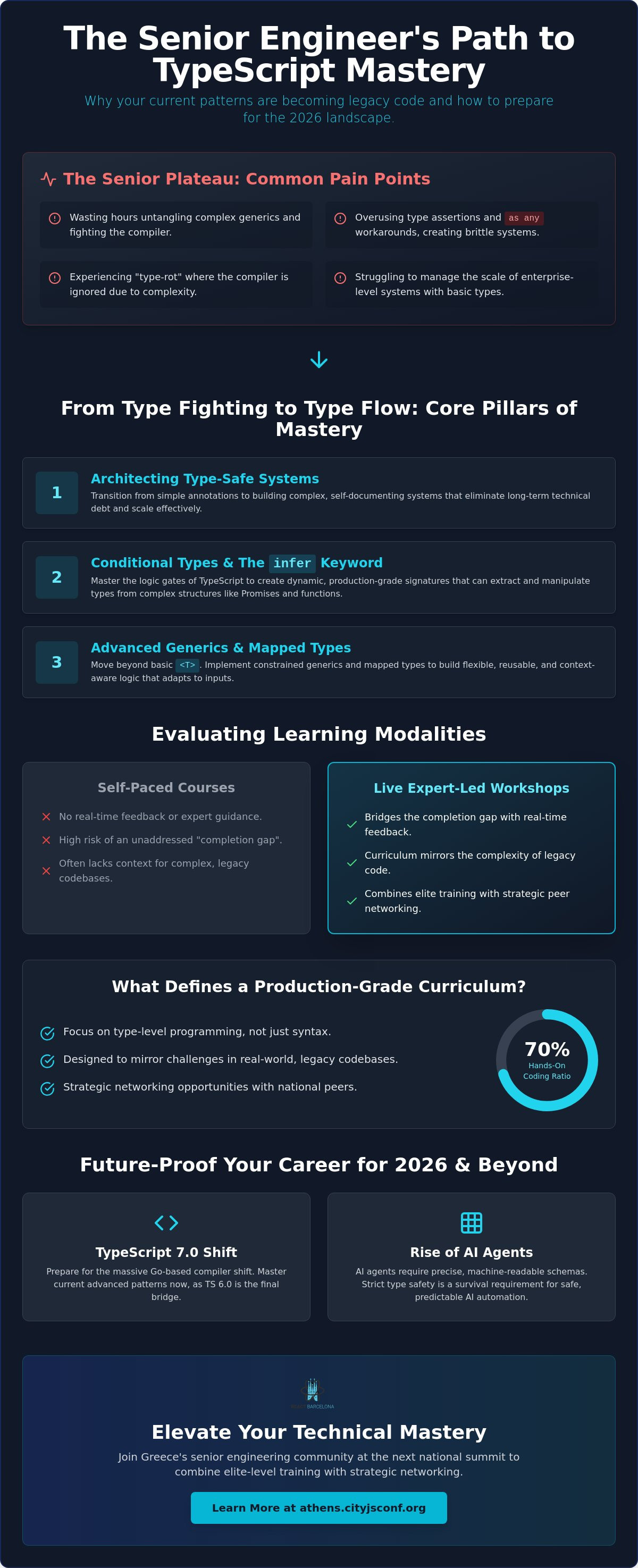
- Transition from simple type annotations to architecting complex, type-safe systems that eliminate long-term technical debt.
- Master the mechanics of conditional types and the "infer" keyword to create dynamic, production-grade signatures for enterprise applications.
- Understand why live, expert-led advanced TypeScript workshops outperform self-paced courses by bridging the completion gap with real-time feedback.
- Identify high-value curricula that maintain a 70% hands-on coding ratio specifically designed to mirror the complexity of legacy codebases.
- Leverage national technical summits to combine elite-level training with strategic networking opportunities among Greece's senior engineering community.
Beyond the Basics: Why Advanced TypeScript Mastery is Non-Negotiable in 2026
Advanced TypeScript has evolved far beyond simple interface declarations. In 2026, it's defined as type-level programming and system architecture. It's the difference between a codebase that merely works and one that is mathematically self-documenting. Senior engineers often hit what we call the "Senior Plateau." This is the point where a solid grasp of TypeScript language fundamentals is no longer enough to manage the complexity of enterprise-scale systems. To move beyond this, you must treat types as a functional programming language in their own right.
The cost of technical debt in brittle, non-generic codebases is higher than ever. Brittle types lead to "type-rot," where the compiler is ignored because it's too difficult to satisfy. This creates a dangerous environment where runtime errors hide behind poorly defined "any" types. For engineering teams in Greece looking to maintain international competitiveness, attending advanced TypeScript workshops is a strategic move to eliminate this debt. These sessions provide the mental models needed to build flexible, reusable logic that adapts to changing business requirements without breaking.
By 2026, the shift toward autonomous AI agents has made strict type safety a survival requirement. These agents require precise, machine-readable schemas to operate within your infrastructure safely. If your type definitions are loose or inconsistent, AI-driven automation becomes unpredictable and risky. High-level mastery ensures that your system's "contracts" are so well-defined that even an autonomous agent can't misinterpret the boundaries of your data.
The ROI of Type-Safe Engineering Architecture
Investing in advanced type safety isn't about satisfying a pedantic compiler; it's about the bottom line. It significantly reduces runtime errors in complex enterprise applications, saving hundreds of hours in debugging and hotfixes. Beyond stability, it transforms the Developer Experience (DX). When your architecture utilizes intelligent inference, the IDE becomes a powerful pair programmer that guides every developer on the team. Type-safe architecture serves as the immutable blueprint for building resilient, high-concurrency Node.js systems that scale across distributed environments.
From Type Fighting to Type Flow
Is your team fighting the compiler or leveraging it? Common signs of struggle include excessive type assertions, "as any" workarounds, or developers spending more time suppressing errors than writing logic. This tension usually stems from a lack of architectural strategy. Transitioning to advanced TypeScript workshops helps shift the team's mindset from "fixing errors" to "designing contracts." Senior developers must lead this charge. By implementing advanced patterns like mapped types and recursive generics, you create a "flow" where the compiler catches architectural flaws before they ever reach a pull request. It's about moving from reactive patching to proactive system design.
Core Pillars of Professional TypeScript Masterclasses
Elite training focuses on the engine, not just the syntax. While the official TypeScript documentation provides the essential foundation, advanced TypeScript workshops push senior engineers to treat the type system as a computational tool. We move beyond basic generics like <T> to explore constrained generics and complex relationships between arguments. This level of mastery allows you to build functions that aren't just type-safe, but context-aware, adapting their return types based on the specific inputs provided at the call site.
Conditional types and the infer keyword represent the true logic gates of the language. These tools allow for dynamic signatures that can "pluck" types out of complex structures. For instance, using infer within a conditional type enables you to extract return types from functions or resolve the inner values of deeply nested Promises. This isn't academic theory. It's a practical necessity when building high-performance middleware or data-fetching layers that must remain flexible yet strictly typed.
Template literal types have transformed string-based API safety. By 2026, manual string casting should be non-existent in professional codebases. Advanced training teaches you to leverage these types for typed CSS-in-JS, route parameters, and event-driven architectures. When combined with assertion functions and type predicates, you create a robust bridge between unpredictable runtime data and your compile-time safety net. You're no longer just checking if a variable exists; you're proving its shape to the compiler through custom validation logic.
Type-Level Programming Concepts
TypeScript acts as a functional language for types. Masterclasses dive deep into recursive types to handle deeply nested data structures like JSON trees or file systems. Mapped types allow you to transform existing interfaces at scale, such as turning every property in a massive enterprise schema into a read-only or optional field with a single declaration. This prevents the "copy-paste" type definition anti-pattern that plagues large-scale projects.
Advanced Patterns for Modern Frameworks
Modern engineering requires deriving types from runtime values to ensure a single source of truth. Using typeof and as const allows you to turn configuration objects directly into type definitions. For library authors and internal tool builders, these patterns are essential for creating a frictionless Developer Experience. If you want to see these patterns in action within a high-intensity peer environment, exploring the curriculum at Athens CityJS provides a clear roadmap for local practitioners. High-performance React and Node.js applications in Greece now demand this level of architectural precision to maintain global standards.
Evaluating Learning Modalities: Self-Paced vs. Live Expert-Led Workshops
Video courses are often where professional development goes to die. While self-paced platforms offer convenience, they suffer from a staggering "Completion Gap" that prevents true mastery among senior staff. For an experienced engineer, watching a pre-recorded demo is a passive experience that rarely translates to production readiness. Advanced TypeScript workshops solve this by replacing isolation with high-intensity, live interaction. You aren't just watching someone code; you're engaging in a real-time architectural dialogue that challenges your existing mental models. This active participation ensures that the concepts actually stick when you return to your daily sprint.
The value of real-time feedback from industry legends like Kyle Simpson cannot be overstated. When you're untangling a complex recursive conditional type, you don't need a "Next Lesson" button. You need an expert who can see your specific edge case and explain the "why" behind the solution. These advanced TypeScript workshops provide a genuine "in-the-trenches" experience where you witness the messy, iterative process of solving difficult problems. This transparency is missing from polished, edited video content where every solution appears magically on the first try. Seeing a master developer debug a type mismatch in real time is a lesson in itself.
The Power of Immersive Technical Training
Mastery requires a dedicated environment free from the distractions of Slack and Jira. Immersive training accelerates growth by forcing you into a flow state alongside peers who share your technical caliber. It's about overcoming the isolation of remote learning. Having direct access to world-class mentors for complex debugging turns hours of frustration into minutes of clarity. This concentrated effort is the most efficient way to bridge the gap between basic competency and wizard-level fluency. You'll leave the session with more than just notes; you'll have a practical toolkit ready for immediate implementation.
Networking and Community Growth
Live workshops are a primary catalyst for building professional engineering leadership. You aren't just learning code; you're connecting with senior engineers across the national ecosystem. Sharing architectural challenges with peers from other enterprise teams provides a unique perspective on how to handle scale. These connections often lead to long-term collaborative relationships that define Senior Web Developer Career Growth Strategies within the Greek market. Building this network is just as vital as the technical skills you acquire. It turns a solitary profession into a shared journey of collective growth and professional ambition.
What to Look for in a Production-Grade TypeScript Curriculum
Senior engineers don't need another walkthrough of the basics. They need to see how types behave when the pressure is on. A production-grade curriculum must prioritize application over abstraction. Look for a hands-on ratio of 70% coding to 30% theory. If you're sitting in a lecture for four hours, you're not learning; you're just spectating. Advanced TypeScript workshops that demand you write code immediately are the only way to build muscle memory for complex patterns. This active engagement is what separates a professional masterclass from a standard tutorial.
Exercises shouldn't be "Hello World" examples. They should mimic the messy reality of enterprise legacy code. We're talking about untyped API responses, deeply nested objects, and third-party libraries with missing definitions. This is where you learn to read "the red squiggles" properly. Diagnosing errors is a core skill that defines senior-level fluency. You should be able to look at a 50-line error message and pinpoint the exact generic constraint that failed within seconds. This diagnostic speed is what restores development velocity in high-scale environments.
Security isn't an afterthought in a high-level curriculum. Advanced training should integrate web app security concepts directly into the type system. By 2026, we use types to prevent common vulnerabilities like injection or data leakage at the compile-time level. If a curriculum doesn't address how type safety reinforces your security posture, it's not ready for the modern enterprise landscape.
Curriculum Depth Checklist
- Abstract Syntax Tree (AST) concepts: Does the course explain how the compiler sees your code? This is vital for creating custom linting rules or codemods that automate team-wide refactors.
- Performance Optimization: Are there modules on optimizing IDE performance? Brittle type definitions can slow down VS Code to a crawl in large monorepos.
- Modern Module Resolution: Verify that the curriculum includes modern ESM and module resolution strategies. These remain the primary source of configuration headaches for Greek engineering teams in 2026.
Instructor Pedigree and Experience
Who is leading the room? Evaluating the real-world engineering background of the workshop leader is mandatory. Seek instructors who contribute to major open-source libraries. They understand the edge cases because they've built the tools we use every day. A "no-nonsense" teaching style is non-negotiable for senior audiences. You want a mentor who skips the fluff and gets straight to the architectural implications of every pattern. If you're ready to test your skills against a production-grade curriculum, secure one of our Professional Workshops at Athens CityJS today.
Elevate Your Technical Mastery at the Next National Summit
CityJS has solidified its position as the premier destination for professional technical training in Greece. It's the only venue where the high-level prestige of global keynotes meets the practical rigor of deep-dive professional workshops. For the senior engineer, this isn't a luxury; it's a strategic necessity. The 2026 summit serves as a critical junction for those navigating the transition to TypeScript 6.0 and the looming architectural shifts of the Go-based compiler in version 7.0. You won't find this level of concentrated expertise anywhere else in the national ecosystem.
The event structure is designed for maximum impact and professional growth. You have access to free community workshops that keep the local grassroots scene vibrant, alongside elite paid tracks for those ready to tackle type-level programming at scale. These advanced TypeScript workshops are where the real work happens. You'll move from listening to doing, guided by mentors who've navigated the exact scaling challenges you face today. Engineering leaders should look toward securing group tickets now to ensure their entire department is aligned on these new standards before the next release cycle.
A Hub for Engineering Leadership and Innovation
Innovation doesn't happen in a vacuum. It requires a hub where engineering leadership can thrive and share "in-the-trenches" experiences. By participating in CityJS, you're investing in the collective growth of the national tech ecosystem. It's about more than just your individual ticket; it's about fostering a culture of excellence that aligns your team with Modern Frontend Architecture Trends. This environment encourages senior practitioners to share architectural challenges and solutions with peers from other high-growth Greek enterprises. You'll leave with a network of social connectors who value the same high-impact information and professional ambition you do.
Securing Your Participation
Securing budget for professional development requires a pragmatic approach. When you justify workshop tuition to your department head, focus on the cost of inaction. Brittle codebases and slow development velocity are significant drains on company resources. The tuition for these sessions is a fraction of the cost of a single major production outage caused by poor type safety. CityJS utilizes tiered registration models to accommodate different team sizes and professional archetypes. Leveraging early bird benefits allows you to maximize your training budget in Euro while securing a spot in the most high-demand sessions. The time for passive learning is over. Secure your place at the upcoming CityJS professional workshops and take the lead in architecting the next generation of type-safe systems.
Architect Your Path to Technical Leadership
Mastering advanced TypeScript workshops means moving beyond simple syntax into the realm of type-level programming. You've seen how bridging the gap between basic annotations and complex, type-safe systems is vital for team velocity and long-term stability. Passive learning through video courses simply can't match the intensity of live, expert-led training where you solve real-world engineering architecture challenges in real time. It's the difference between merely shipping code and building a self-documenting ecosystem that scales.
As part of the prestigious global CityJS Network, CityJS Athens 2026 offers a unique opportunity to learn from industry legends like Kyle Simpson and Tejas Kumar. Don't let your skills plateau while the ecosystem shifts toward the high-performance Go-based compiler era. It's time to transition from fixing errors to designing resilient contracts. Register for Professional Workshops at CityJS Athens 2026 and join an elite community dedicated to engineering excellence. We look forward to seeing you push the boundaries of what's possible in the Greek tech landscape.
Frequently Asked Questions
What specifically makes a TypeScript workshop "advanced" rather than intermediate?
Advanced workshops focus on type-level programming and system architecture rather than just syntax. We move beyond basic interfaces to explore recursive types, mapped types, and complex conditional logic. It's about treating the type system as a functional language to design robust, self-documenting contracts for enterprise systems. You'll learn to architect flexible logic that adapts to changing business requirements without breaking.
How do live workshops compare to self-paced platforms like Total TypeScript?
Live advanced TypeScript workshops provide real-time architectural dialogue and immediate expert feedback. Unlike self-paced video platforms, these sessions offer the accountability and intensity needed to master complex edge cases. You're part of a high-intensity peer environment that eliminates the isolation of remote learning. This active participation ensures that difficult concepts actually stick when you return to your daily production environment.
What are the prerequisites for attending a senior-level TypeScript masterclass?
Can my company purchase group tickets for our entire engineering team?
Engineering leaders can certainly purchase group tickets to align their entire department on advanced standards. This is often the most effective way to implement team-wide architecture strategies and improve overall developer experience. Investing in group training reduces long-term maintenance costs by ensuring everyone uses the same high-performance patterns. It's a pragmatic move for Greek engineering teams aiming for international competitiveness in 2026.
Will these workshops cover React-specific patterns or general TypeScript?
The curriculum balances general type theory with framework-specific applications for React and Node.js. You'll explore patterns that derive types from runtime values and manage deeply nested data structures common in modern frontend ecosystems. This ensures the training is directly applicable to your current production stack. We focus on patterns that improve both the safety and the velocity of your specific development environment.
Are there free community workshops available alongside the professional tracks?
Yes, we offer Free Community Workshops to support the local grassroots ecosystem in Greece. These run parallel to our elite-level Professional Workshops designed for senior engineers. This dual-track approach ensures that high-quality technical education remains accessible while providing a dedicated space for deep-dive professional training. It's part of our commitment to the collective growth of the national tech community.
What is the typical hands-on coding ratio in a CityJS workshop?
We maintain a strict 70% hands-on coding to 30% theory ratio. Advanced TypeScript workshops at CityJS prioritize active engagement over passive listening to build muscle memory for complex production patterns. You'll spend the majority of the session solving exercises that mimic the messy reality of enterprise legacy code. This "in-the-trenches" approach is the most efficient way to achieve wizard-level fluency.
How does advanced TypeScript training impact long-term career growth for senior devs?
Mastery transitions you from a developer who writes code to an architect who designs type-safe systems. This skill set is a key differentiator for leadership roles and managing high-scale enterprise infrastructure in 2026. It provides the technical authority needed to lead teams through major ecosystem shifts, such as the upcoming Go-based compiler transition. You'll leave with the tools to implement superior DX across your entire organization.


