
RAG is no longer a prompt engineering challenge; it is a rigorous systems architecture problem. While spinning up a basic vector search is trivial, maintaining a deterministic, low-latency pipeline under production load is where most engineering teams stumble. You've likely felt the frustration of unpredictable hallucinations or the sticker shock of unoptimized token usage. It's a common hurdle for senior developers tasked with bridging the gap between a flashy AI prototype and a resilient, scalable service.
Mastering the art of building RAG applications with Node.js requires moving beyond basic wrappers and diving into the in-the-trenches realities of data orchestration. This 2026 engineering guide provides the architectural blueprint you need to regain control over your AI stack. We'll explore advanced retrieval techniques, evaluate the current vector database ecosystem, and establish clear metrics for performance. This isn't about theoretical abstractions. It's about giving you the technical confidence to lead your team through the complexities of production AI integration with the precision of a seasoned architect.
Key Takeaways
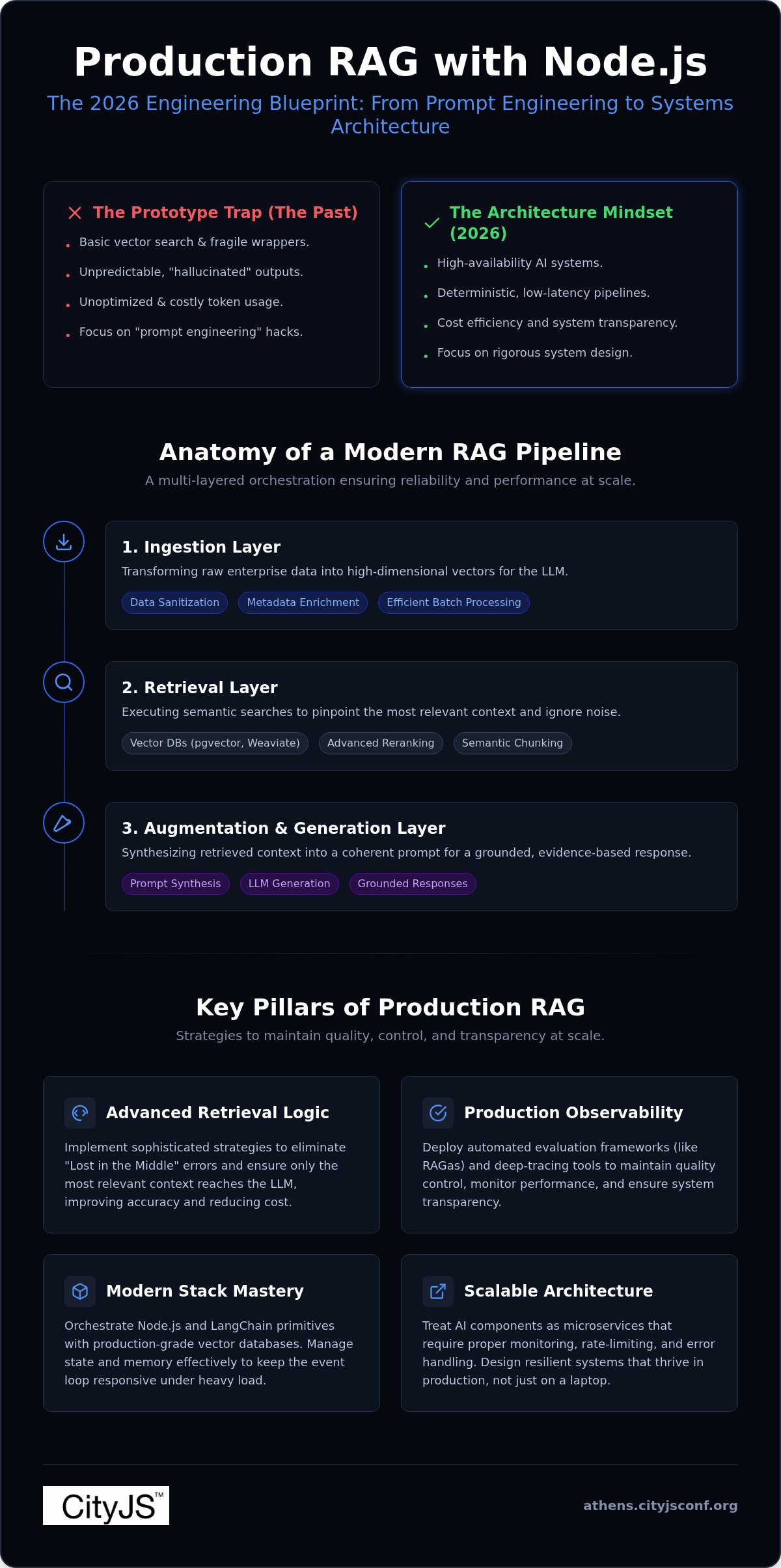
- Shift to Systems Architecture: Move beyond basic wrappers to design high-availability AI systems that prioritize deterministic outputs and cost efficiency.
- Modern Stack Mastery: Learn the nuances of building RAG applications with Node.js by orchestrating LangChain primitives with production-grade vector databases like pgvector and Weaviate.
- Advanced Retrieval Logic: Implement semantic chunking and reranking strategies to eliminate "Lost in the Middle" errors and ensure context-aware data retrieval.
- Production Observability: Deploy automated evaluation frameworks like RAGas and deep-tracing tools to maintain quality control and system transparency at scale.
- Practical Implementation: Bridge the gap between engineering theory and "in-the-trenches" reality through professional, senior-level technical workshops.
Beyond the Wrapper: Why Production RAG in Node.js Requires an Architect’s Mindset
The era of AI experimentation has ended. By 2026, high-availability systems have replaced the fragile, experimental scripts of previous years. Retrieval-Augmented Generation (RAG) is a bridge between static enterprise data and dynamic LLM reasoning capabilities. It's the architecture that allows a Large Language Model to access private, real-time datasets without the prohibitive costs or risks of constant fine-tuning. For the senior engineer, this evolution means moving beyond the novelty of "Chat with PDF" and toward building resilient, scalable infrastructure.
Node.js is uniquely positioned for this evolution. Its non-blocking I/O model effectively handles the high-concurrency demands of multiple API calls to vector databases and LLM providers simultaneously. When building RAG applications with Node.js, you're leveraging an ecosystem designed for low latency and rapid scaling. However, the core challenge remains a delicate balance. You must optimize for latency, maximize accuracy, and minimize token expenditure at scale. Data is the fuel. Architecture is the engine.
The Anatomy of a Modern RAG Pipeline
A production-grade pipeline isn't a single function call. It's a multi-layered orchestration of data moving through distinct stages. Each stage requires specific engineering decisions to ensure reliability and performance.
- Ingestion Layer: Transforming raw enterprise data into high-dimensional vectors. This requires robust sanitization, metadata enrichment, and efficient batch processing to ensure the LLM has high-quality context.
- Retrieval Layer: Executing semantic searches against vector databases. The goal is pinpointing the most relevant context while ignoring the noise of irrelevant data points that drive up costs.
- Augmentation & Generation: Synthesizing the retrieved context into a coherent prompt. This is where the LLM generates a grounded response based on the provided evidence rather than general training data.
Why Senior Engineers Must Lead the AI Transition
The technical debt of the past few years was often built on fragile AI wrappers. Senior engineers are now being called to clean up the mess. Moving beyond "prompt engineering" means treating AI components as just another microservice that needs monitoring, rate-limiting, and error handling. Building RAG applications with Node.js at this level demands a no-nonsense approach to system design. You're not just writing code; you're curating the knowledge flow of your entire organization. This transition is about depth, complexity, and the practical implementation of global thought leadership in a local, professional context. It's the difference between a prototype that works on a laptop and a system that thrives in production.
The Modern Node.js AI Stack: Orchestrating LangChain, Vector Databases, and LLMs
Engineering an AI stack in 2026 isn't about finding a "magic" tool. It's about creating synergy between your runtime, your data, and your models. When building RAG applications with Node.js, the orchestrator you choose dictates the long-term maintainability of your entire system. You aren't just connecting APIs; you're managing a complex flow of high-dimensional data that must remain performant under load. This requires a shift from simple scripting to rigorous system design.
Managing state and memory in long-running Node.js processes presents a unique challenge. Unlike stateless REST APIs, AI workflows often involve multi-turn conversations and large context windows that can strain the heap if not handled correctly. Senior teams are moving toward externalizing memory into Redis or dedicated state machines to keep the Node.js event loop responsive. For those ready to dive into these complexities, joining professional AI workshops provides the hands-on experience needed to navigate these architectural crossroads.
Orchestration Frameworks: LangChain vs. Custom Architectures
LangChain.js remains the dominant force for rapid prototyping, offering a vast library of pre-built integrations. However, the "LangChain tax" is real. The heavy abstractions can sometimes obscure the underlying logic, making debugging difficult in production. LlamaIndex.ts has carved out a niche for data-heavy applications, providing superior tools for indexing and query engines. Many elite teams are now opting to build custom primitives. This "no-nonsense" approach allows for surgical control over the execution flow. Integrating these tools with a high-performance Node.js architecture ensures that your AI agents don't become the bottleneck of your infrastructure.
Vector Storage: Where Performance Meets Persistence
The vector database landscape has matured significantly. Choosing the right storage is a matter of scale and existing infrastructure. Building RAG applications with Node.js often involves one of three paths:
- pgvector for PostgreSQL: The pragmatic choice for teams already invested in the SQL ecosystem. It allows you to keep your vectors and relational data in the same ACID-compliant house.
- Pinecone: The serverless leader for teams that want to outsource the operational overhead of vector indexing. It’s ideal for rapid scaling without managing infrastructure.
- Weaviate: A powerful choice for those requiring self-hosted solutions to maintain data sovereignty or complex multi-modal search capabilities.
Embedding models have also evolved. While OpenAI’s models offer ease of use, Cohere and local HuggingFace models are gaining traction for their cost-effectiveness and privacy. Local embeddings, in particular, allow you to keep sensitive data within your own network, a critical requirement for national-level enterprise projects. The goal is always the same: minimize query latency while maximizing the relevance of the retrieved context.
Refining the Retrieval: Advanced Chunking, Embedding, and Reranking Strategies
Retrieval is the heartbeat of any RAG system. If your pipeline feeds irrelevant or fragmented context to the LLM, the quality of the generation will inevitably collapse. Most developers treat retrieval as a black box; they ingest data, generate embeddings, and hope the vector database handles the rest. In a production environment, this lack of precision leads to the "Lost in the Middle" problem, where models struggle to identify the most relevant information when it's buried in a long context window. Successful building RAG applications with Node.js requires a more surgical approach to how data is sliced and re-evaluated before it ever reaches the prompt.
Hybrid search is the first line of defense against retrieval drift. While vector-based semantic search is powerful for finding conceptual matches, it often fails on specific technical terms, SKU numbers, or unique identifiers. Combining BM25 keyword search with vector similarity ensures that your system captures both the "vibe" and the "facts." This dual-track approach is non-negotiable for enterprise documentation where a single missing digit or term can render an answer useless. Balancing the cost-performance trade-offs of embedding models like OpenAI’s text-embedding-3-small versus specialized models from Cohere or local HuggingFace deployments is the hallmark of an architect's mindset.
Chunking Strategies for Complex Documents
Moving beyond simple character counts is essential for maintaining context. Recursive Character Text Splitters are a reliable baseline, but they're often too blunt for technical manuals or legal contracts. Semantic chunking uses the embedding model itself to detect when a topic has shifted, creating breaks based on meaning rather than punctuation. This ensures each chunk is a coherent, self-contained unit of information. Optimizing chunk size is the primary lever for ensuring your LLM operates at peak context window efficiency without wasting tokens on irrelevant data. Metadata enrichment, such as attaching parent document IDs or section headers to each chunk, allows for more granular filtering during the retrieval phase.
Reranking: The Secret to Production Accuracy
Initial retrieval is often noisy, returning a "Top-K" list that includes several irrelevant outliers. Reranking acts as a secondary, high-precision filter. By implementing Cross-Encoders like Cohere or BGE-Reranker within your Node.js service, you can re-score the initial results to ensure only the most pertinent data is sent to the LLM. While this adds a small amount of latency, the gain in accuracy is profound. When building RAG applications with Node.js, you must decide where to place this computational load:
- Vector-only: Lowest latency, but susceptible to noise and "hallucinated" relevance.
- Hybrid Search: Balanced and reliable for technical datasets or structured data.
- Reranked: The gold standard for production, ensuring maximum precision in high-stakes environments.
The goal is to find the sweet spot where your reranking logic provides enough signal to eliminate hallucinations without blowing your latency budget.
Building Scalable Pipelines: Error Handling, Evaluation, and Observability
Standard error handling is insufficient for non-deterministic systems. In traditional software engineering, a failure is usually a crash or a 404 error. In AI engineering, a failure is often a confident hallucination or a subtly irrelevant retrieval. When building RAG applications with Node.js, your architecture must account for these "silent" failures. You aren't just managing code execution; you're managing the integrity of information. Moving from a "Hello World" prototype to a production pipeline requires a rigorous shift toward automated evaluation and deep observability.
Reliability also demands robust fallback strategies. LLM providers will hit rate limits, and APIs will experience latency spikes. High-availability Node.js apps should implement circuit breakers and model-level redundancy. If your primary frontier model is throttled, your system should automatically pivot to a secondary provider or a local, self-hosted instance to maintain service continuity. Security is equally paramount. You must implement PII filtering at the ingestion layer and guardrails against prompt injection to ensure your retrieval engine doesn't become a vector for data exfiltration.
The RAG Evaluation Lifecycle
You cannot improve what you do not measure. Evaluation frameworks like RAGas allow you to quantify the performance of your pipeline using three critical metrics: Faithfulness, Answer Relevance, and Context Precision. Faithfulness ensures the LLM's response is derived strictly from the retrieved context, while Context Precision measures the quality of your vector search results. Integrating AI implementation for software teams into your CI/CD pipeline ensures that every code change is benchmarked against these metrics. This systematic approach prevents regression and ensures that "optimizing" one part of the chain doesn't inadvertently break another.
Observability and Debugging
Traditional logging fails when you need to understand why an LLM reached a specific conclusion. You need to visualize the "Chain of Thought" and inspect the exact chunks retrieved during the process. Tools like LangSmith or custom OpenTelemetry setups provide the necessary tracing to debug retrieval failures in real time. Cost tracking is another essential pillar of observability. By monitoring token usage per request or user, you can identify unoptimized prompts or inefficient chunking strategies that are draining your budget. Building RAG applications with Node.js at scale is as much about financial governance as it is about technical execution.
Mastering these observability patterns is best done through hands-on experience. To move beyond the theory and implement these strategies in a production environment, consider joining our professional AI engineering workshops for deep-dive technical training.
Bridging the Theory Gap: Master RAG at the National Engineering Summit
Reading about architecture is a vital first step, but it's rarely enough to survive a production deployment. The distance between a successful local prototype and a resilient, enterprise-grade system is paved with edge cases that documentation often ignores. When building RAG applications with Node.js, the most expensive mistakes aren't made in the code; they're made in the architecture. For senior engineers in Greece, the shift toward in-person masterclasses reflects a growing need for deep-dive technical clarity that online tutorials simply cannot provide. This isn't just about learning a new library. It's about refining your mindset as an architect and securing your place at the forefront of the AI transition.
Mastery requires a deliberate move away from isolated experimentation toward collaborative, professional-grade training. You need to see how global thought leaders handle the same latency and accuracy trade-offs you face daily. By engaging with the practical, "in-the-trenches" reality of high-availability AI, you move beyond being a consumer of tools to becoming an elite curator of your team's technical stack. The sense of urgency is real; the window to lead these AI integrations is now.
From Code Snippets to Production Systems
Expert-led workshops bridge the gap between theory and reality. While a code snippet might show you how to call an API, a professional workshop led by industry veterans like Kyle Simpson or Tejas Kumar forces you to confront the messy realities of production-ready RAG. You'll collaborate on complex architectures, stress-test your retrieval logic, and learn how to justify these technical investments to your engineering leadership. This isn't a coding bootcamp. It's a senior-level track designed for those who understand that depth and complexity are the only paths to true reliability.
Join the National Engineering Community
The software engineering community Athens is the epicenter of this technical renaissance. Networking with global industry leaders and local peers provides a unique perspective on navigating the specific challenges of our market, from data sovereignty to local infrastructure constraints. These connections often result in shared professional journeys that outlast any single conference session. Position yourself among the elite by engaging directly with CTOs and Lead Architects who are actively shaping the future of AI integration. Don't let your professional development remain a theoretical goal. Secure your Early Bird tickets for CityJS Athens 2026 today and transform your knowledge into production-grade engineering excellence.
Mastering the Future of Node.js AI Architecture
Production-grade AI is a systems engineering challenge. The transition from basic wrappers to resilient infrastructure requires a fundamental shift in how we approach retrieval and reliability. Success depends on mastering the nuances of semantic chunking, implementing high-precision reranking, and establishing automated evaluation frameworks that measure faithfulness. Building RAG applications with Node.js is no longer a niche experiment; it's the core competency of the modern senior engineer who values deterministic behavior over prompt-driven guesswork.
As the national hub for professional JavaScript and AI discourse, we invite you to move beyond theory and engage with the practical, in-the-trenches realities of AI architecture. Register for professional AI and Node.js workshops at CityJS Athens 2026 to learn directly from industry legends like Kyle Simpson and Tejas Kumar. These hands-on workshops are specifically designed for senior engineering levels to ensure you leave with the technical confidence to lead your team through the complexities of the AI transition. The future of our professional ecosystem is being built today. We look forward to seeing you there.
Frequently Asked Questions
Is Node.js as good as Python for building RAG applications?
Node.js is often superior for the orchestration layer due to its event-driven, non-blocking I/O and efficient handling of concurrent API requests. While Python remains the standard for model training, building RAG applications with Node.js allows for tighter integration with modern web stacks and lower latency in high-traffic environments. It's about choosing the right tool for the system architecture, not just the model. This makes it ideal for real-time production systems.
What is the best vector database to use with Node.js in 2026?
The best choice depends on your infrastructure. pgvector for PostgreSQL is the pragmatic choice for teams wanting to keep relational and vector data together. For specialized, high-scale semantic search, Weaviate and Pinecone offer superior indexing performance. pgvector provides a mature, ACID-compliant environment that simplifies data management. It allows you to leverage existing SQL knowledge while scaling your AI capabilities without adding entirely new database paradigms to your stack.
How do I prevent hallucinations in my RAG system?
Hallucinations are mitigated through rigorous grounding and high-precision reranking. By using a reranker like Cohere to filter retrieved chunks and applying evaluation frameworks like RAGas, you ensure the LLM generates responses based only on verified evidence. This no-nonsense approach moves beyond simple prompt engineering. It focuses on the architectural integrity of the data pipeline. Consistent evaluation in your CI/CD pipeline prevents accuracy regressions and ensures your outputs remain deterministic.
Can I build a RAG application using local LLMs to save on costs?
Yes, local LLMs like Llama 3 or Mistral are viable for cost reduction and data privacy in 2026. Deploying these models within your infrastructure using tools like Ollama or vLLM allows you to avoid per-token pricing. This approach is particularly valuable for processing sensitive enterprise data that cannot leave your network. While it requires more upfront infrastructure management, the long-term savings and security benefits are significant for national-level projects.
What are the most important metrics for evaluating RAG performance?
Faithfulness, Answer Relevance, and Context Precision are the three pillars of RAG evaluation. Faithfulness ensures the LLM's response is derived strictly from the retrieved context. Answer Relevance measures how well the response addresses the user's query. Context Precision evaluates the quality of your vector search results. Monitoring these metrics allows you to identify exactly where a pipeline is failing. It turns the debugging process from guesswork into a precise engineering task.
Do I need a GPU-enabled server to run a Node.js RAG backend?
A GPU is not strictly necessary for the Node.js backend itself, but it is essential if you are hosting your own embedding models or local LLMs. If you rely on external APIs for embeddings and generation, a standard CPU-optimized server is sufficient for orchestrating the pipeline. The Node.js layer acts as the traffic controller. It manages the flow of data between your users, the vector database, and the external inference engines.
How does chunking impact the accuracy of my retrieval?
Chunking directly influences the signal-to-noise ratio of your retrieval process. Small chunks might lose vital context, while overly large chunks dilute the semantic signal and waste tokens. Semantic chunking ensures that data is split based on thematic shifts rather than arbitrary character counts. This improves the accuracy of the context fed to the LLM. It is a critical lever for ensuring your system operates at peak context window efficiency.
Where can I get professional training on AI integration in Greece?
You can access elite technical training at CityJS Athens 2026. This national conference features intensive workshops on building RAG applications with Node.js led by global experts like Kyle Simpson and Tejas Kumar. It's a professional hub designed for senior engineers who prioritize practical, real-world implementation over abstract theory. Securing a spot in these masterclasses allows you to bridge the gap between engineering theory and production-grade AI integration with confidence.


