

In 2026, the most expensive technical debt isn't found in your legacy code; it's buried in an architecture that's blind to the AI revolution. If your current stack feels like a bottleneck for scaling teams or performance, you're not alone. Most engineering leaders are grappling with the friction of outdated monolithic structures while trying to decipher which modern frontend architecture trends actually deliver production-grade value. It's a common challenge to balance the rapid evolution of tools like React 19.2.8 with the practical need for stable, scalable systems.
We've reached a tipping point where traditional organization isn't enough. You need a system that handles the mounting requirements of the European Accessibility Act and the performance demands of edge-side rendering. This guide provides the high-level professional clarity you need to move from confusion to execution. We'll strip away the noise to master the shifts defining the year, from AI-first design to the practical application of TypeScript as the global standard for professional development.
By the end of this deep dive, you'll have a clear framework for choosing an architecture that scales. We'll explore the real-world utility of the latest frameworks, analyze the impact of AI on system design, and outline actionable strategies to optimize performance for the most demanding enterprise environments.
Key Takeaways
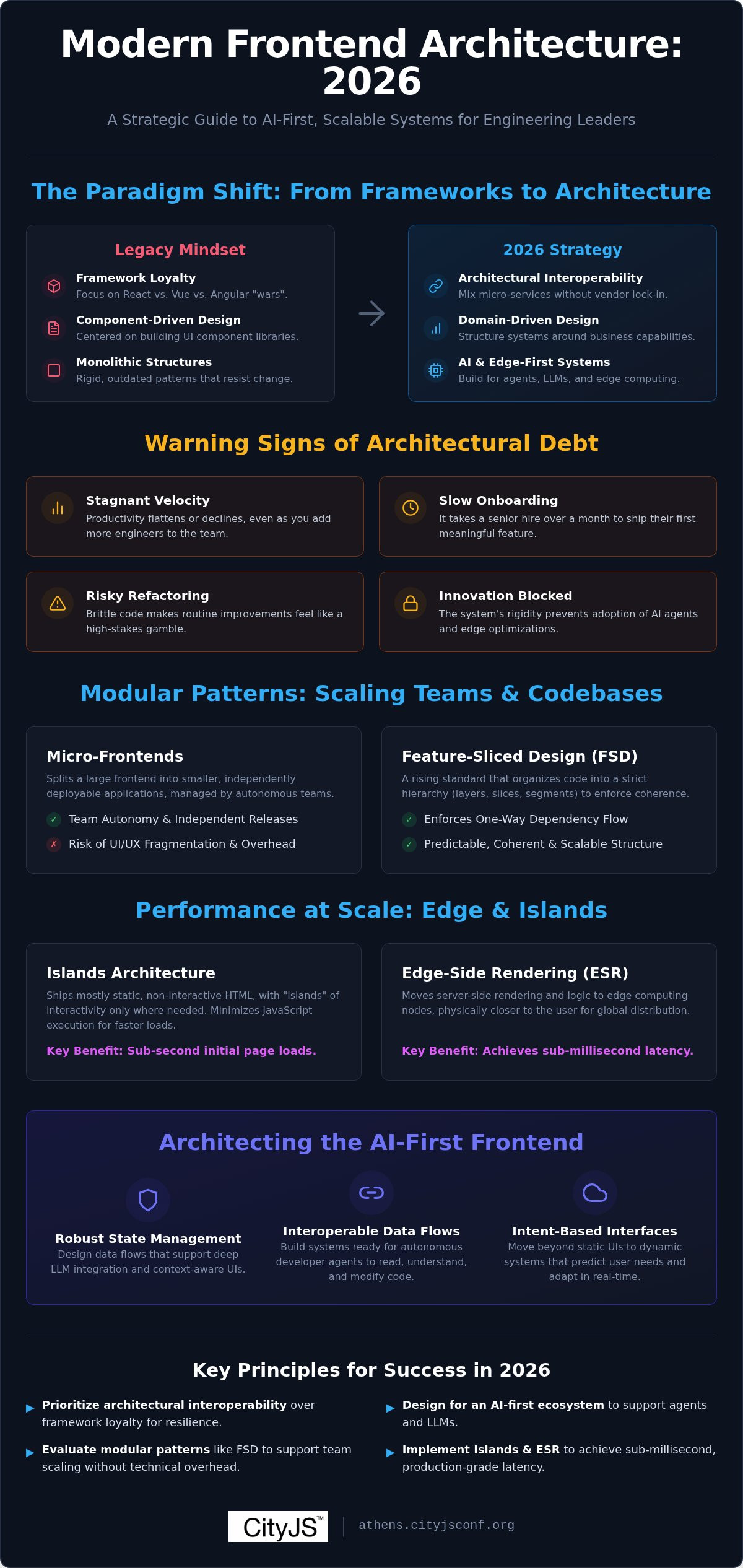
- Prioritize architectural interoperability over framework loyalty to build a resilient bridge between complex business logic and high-performance user experiences.
- Evaluate the trade-offs between Micro-Frontends and Feature-Sliced Design (FSD) to ensure your modular patterns support team scaling without creating unnecessary technical overhead.
- Design for an AI-first ecosystem by architecting state management and data flows that support autonomous developer agents and deep LLM integration.
- Implement Islands Architecture and Edge-Side Rendering (ESR) to minimize JavaScript execution and achieve the sub-millisecond latency required for production-grade systems.
- Vet modern frontend architecture trends through high-level peer networking to validate technical theories against the practical realities of production environments.
Beyond Frameworks: Why Modern Frontend Architecture Trends in 2026 Demand a Strategic Shift
The framework wars of the last decade have finally cooled. Engineering leaders in 2026 recognize that the real battleground isn't the choice between React, Vue, or Angular, but the underlying structure that supports them. Frontend architecture serves as the vital bridge between complex business logic and the end-user experience. As we analyze modern frontend architecture trends, the focus has shifted toward architectural interoperability. This allows teams to mix and match micro-services and micro-frontends without being locked into a single ecosystem. This shift is driven by 2026 hardware capabilities and advanced browser APIs that support more sophisticated, decentralized workloads.
We're moving from a "Component-Driven" mindset to "Domain-Driven" design. It's no longer enough to build a library of UI components; you must architect systems around business domains to ensure that the frontend can evolve alongside the backend. This approach draws heavily from the principles of Web-Oriented Architecture (WOA), ensuring that web applications remain lightweight, service-oriented, and ready for AI consumption. By aligning your frontend structure with business capabilities, you create a system that is resilient to the rapid churn of the JavaScript ecosystem.
The Cost of Architectural Debt
How do you know if your current structure is failing? If your developer velocity has plateaued despite adding more headcount, you're likely paying high interest on architectural debt. You'll see it in the friction of team onboarding. When it takes a month for a senior hire to ship a meaningful feature, your architecture is the bottleneck. Brittle codebases make refactoring feel like a high-stakes gamble rather than a routine task. In 2026, architectural debt is the cumulative burden of rigid, monolithic design patterns that prevent a system from adopting autonomous AI agents and edge-first performance optimizations.
2026: The Year of the "Smart Frontend"
Edge computing has fundamentally decentralized the frontend. We've moved away from the "thick client" or "thick server" debate toward a distributed model where logic lives at the edge. This transition enables intent-based interfaces. Instead of static UIs, we're building dynamic systems that predict user needs and adjust in real-time. To support this, senior leaders must prioritize high-performance Node.js architecture within their backend-for-frontend (BFF) layers. A robust BFF layer acts as the orchestrator for these modern frontend architecture trends, ensuring that the frontend has the data density it needs without sacrificing sub-millisecond response times.
Modular Patterns: Comparing Micro-Frontends, Feature-Sliced Design, and Latest JavaScript Framework Trends
Modularity is the antidote to the monolithic bottlenecks that throttle developer velocity. In 2026, the conversation has moved beyond the basic ability to split code. It's now focused on how to maintain coherence across massive systems. These modern frontend architecture trends prioritize clear boundaries and predictable data flows. Most enterprise leaders now favor monorepos for shared governance. Tools like Nx and Turborepo have matured to solve the scaling issues that once made polyrepos attractive. You get unified linting and type-safety across the entire stack without sacrificing the independence of individual sub-applications.
Feature-Sliced Design (FSD) Deep Dive
FSD has emerged as the rising standard for modular React and Vue applications. It organizes code into a strict hierarchy that enforces a one-way dependency flow. This prevents the "big ball of mud" common in older codebases. The structure is broken down into specific layers:
- App: Global setup, providers, and high-level styles.
- Processes: Complex, multi-page business flows.
- Pages: The composition of features and entities into full views.
- Features: User-facing actions that carry business value, like "Add to Cart."
- Entities: Business domain logic, such as a "User" or "Product" model.
- Shared: Reusable UI kits, helpers, and configuration.
Scaling medium-to-large teams becomes significantly easier with FSD because it answers the "where does this go" question once and for all. Migrating from a type-based structure requires a methodical shift. Start by mapping your existing components to business domains before physically moving files into the FSD layers.
The State of Micro-Frontends in 2026
Micro-frontends are no longer a silver bullet. They're a solution for organizational scaling, not technical performance. With the evolution of Module Federation, runtime integration is smoother than ever. Pitfalls still exist. Shared dependencies can lead to version mismatches if you don't implement strict version contracts. CSS isolation is also a primary concern, often requiring Shadow DOM or scoped CSS-in-JS solutions. Decide if you truly need this approach. If your engineering team is under 50 people, the overhead of micro-frontends often outweighs the benefits of independent deployments.
Evaluating the latest JavaScript framework trends requires an architectural lens. React 19.2.8 and Vue 3.6.0 are designed to support these modular patterns natively. They aren't just libraries; they're enablers for the complex systems we build today. If you're looking to validate these patterns with peers, attending a professional workshop provides the real-world context that documentation lacks.
The AI-First Frontend: Architecting for LLMs and Autonomous Developer Agents
The integration of Large Language Models (LLMs) has evolved from a novelty feature into a primary architectural constraint. In 2026, modern frontend architecture trends are defined by how well a system accommodates non-deterministic inputs and autonomous developer agents. We're moving beyond simple wrappers for chat APIs. Engineers are now building "AI-Ready" component systems. These are structured libraries where components are annotated with metadata that allows LLMs to understand their purpose, props, and relationship to the data layer. This machine-readability is essential for agents that need to dynamically assemble UIs or perform automated debugging.
Vector databases and client-side embeddings are becoming standard parts of the frontend stack. By running light embedding models in the browser, applications can handle semantic search and context retrieval locally. This reduces latency and improves privacy. It's a significant shift from the traditional model where all intelligence lived behind a REST or GraphQL endpoint. These local vector stores enable Retrieval-Augmented Generation (RAG) directly on the client, allowing for a more personalized and responsive user experience.
Building for Intent-Based UI
AI is fundamentally shifting the user experience from a "Click-to-Action" model to an "Intent-to-Result" flow. Users no longer need to navigate deep menu hierarchies; they express an intent, and the frontend must dynamically render the necessary generative UI components. This requires a highly flexible rendering engine. You need an architecture that can hydrate components on the fly based on schemas returned by an LLM. Security is paramount here. Executing AI-generated logic on the client side introduces risks like prompt injection affecting UI state. Robust sandboxing and strict validation of generative outputs are non-negotiable requirements for any production-grade system.
The Impact on State Management
Traditional Flux patterns were designed for predictable, user-triggered events. They're struggling to keep up with the streaming nature of AI. Modern state management must handle continuous data chunks and real-time feedback loops without causing unnecessary re-renders. We're seeing a move toward fine-grained reactivity that can pause, resume, or roll back state based on the confidence scores of an AI agent's output. AI-driven state management prioritizes non-deterministic, streaming data flows over the predictable, action-triggered transitions of Redux or Zustand. By embracing these modern frontend architecture trends, technical leaders ensure their applications can handle the chaotic but powerful nature of autonomous agents.
Performance at Scale: Implementing Islands Architecture and Edge-Side Rendering
The era of the bloated Single Page Application (SPA) is ending. Engineering leaders now realize that shipping megabytes of JavaScript is a performance dead end. We're witnessing a strategic return to multi-page apps (MPAs) and the widespread adoption of Islands Architecture. This pattern delivers static HTML with specific "islands" of interactivity. It minimizes the JavaScript tax on the browser. It stands as one of the most impactful modern frontend architecture trends for teams managing data-heavy enterprise systems. By isolating interactive elements, you prevent a single complex component from degrading the performance of the entire page.
Edge-Side Rendering (ESR) is the next evolution. Logic is moving closer to the user. ESR allows you to personalize content at the network edge. You get sub-millisecond latency that traditional server-side rendering can't match. This isn't just a speed play. It's a necessity for optimizing Core Web Vitals like Interaction to Next Paint (INP). By offloading processing from the main thread to the edge, you ensure the UI remains responsive even during complex data fetches and heavy state transitions.
The Rise of the Edge
Platforms like Vercel, Cloudflare, and Netlify have redefined the deployment boundary. You aren't deploying to a single region anymore. You're deploying to a global network. This requires a fundamental shift in how we architect state. Managing globally distributed data at the edge involves utilizing edge-compatible databases and distributed KV stores. The ROI of this migration is clear. You see it in reduced egress costs and a superior global user experience that doesn't degrade with distance. It's about building systems that are resilient to regional outages and high-latency mobile networks.
Hydration Strategies for 2026
Effective hydration is the linchpin of mobile performance. We've moved beyond the "all-or-nothing" approach that characterized early SSR implementations. Consider these strategies to reduce the execution burden:
- Partial Hydration: Hydrate only the interactive components, leaving the rest as static HTML to save CPU cycles.
- Progressive Hydration: Trigger hydration only when a component enters the user's viewport or after a specific user interaction.
- Resumable Hydration: Use a Qwik-style approach to serialize the application state, eliminating the initial execution phase entirely for instant-on interactivity.
Evaluating frontend performance best practices in 2026 requires a deep dive into these hydration patterns. If you're ready to implement these high-scale systems, secure your Conference Day Pass to learn from the architects leading these shifts.
Mastering Architectural Shifts: Professional Development for Senior Engineers
Technical theory is a foundation, not a finish line. You can read every RFC for React 19.2.8, but without community context, you lack the perspective to see how those changes impact a 50-person engineering team. Mastering modern frontend architecture trends requires a shift from individual execution to strategic oversight. This evolution is best supported through high-level engineering leadership networking. Connecting with peers allows you to vet new patterns against the "in-the-trenches" experiences of other technical executives. It's the difference between following a trend and making a calculated investment.
Leading an architectural migration is a high-stakes cultural challenge. It's not just about the code; it's about managing the cognitive load of your developers. To avoid burnout, migrations must be incremental and value-driven. Start with a pilot project that solves a visible pain point. This builds the internal social capital you'll need for larger, more disruptive shifts. National engineering summits play a vital role here, offering a space to learn how other organizations have successfully navigated these transitions without losing their best talent.
From Senior Developer to Architect
Developing the "Architectural Eye" means learning to spot the difference between transformative shifts and ephemeral hype. This pattern recognition only comes from seeing multiple systems fail and succeed. Hands-on workshops are critical for this growth. They provide a safe environment to break things and understand the "why" behind complex patterns like resumable hydration or Feature-Sliced Design. Don't build in a vacuum. Building a personal network of technical peers allows for informal peer-reviews of your architecture before you commit significant company resources to a new direction.
The National Engineering Ecosystem
In-person summits remain the premier venue for acquiring high-impact information. While digital documentation is ubiquitous, the most valuable insights are often the "gotchas" and failed experiments shared in the hallways. These gatherings allow you to bring specific enterprise challenges to global thought leaders for direct feedback. Expert-led sessions provide the depth required to solve complex scaling issues that aren't covered in basic tutorials. Justifying professional development budgets for high-level technical training is a matter of ROI. The cost of a single misaligned architectural choice far outweighs the price of a Conference Day Pass or a Professional Workshop. Investing in these opportunities ensures your team remains at the forefront of modern frontend architecture trends while maintaining production-grade stability.
Architecting the Future of Web Engineering
The landscape of 2026 demands more than just a passing familiarity with libraries. It requires a strategic commitment to systems that are modular by design and AI-ready by default. We've moved beyond the framework wars into an era where architectural interoperability and edge-side rendering define the elite engineering organization. Success now hinges on your ability to implement patterns like Feature-Sliced Design and Islands Architecture while navigating the complexities of autonomous developer agents.
Staying ahead of these modern frontend architecture trends requires more than reading documentation; it requires high-level peer validation. You can master these trends at the next National JavaScript Summit. Join 500+ senior engineering peers for keynotes from industry leaders like Kyle Simpson and engage in deep-dive professional workshops on FSD and AI. This is your opportunity to bridge the gap between technical theory and production-grade execution. Let's build the next generation of the web together.
Frequently Asked Questions
What is the most popular frontend architecture pattern in 2026?
Feature-Sliced Design (FSD) has become the dominant pattern for large-scale applications in 2026. It replaces the chaotic folder structures of the past with a strict, domain-driven hierarchy. This approach allows teams to manage modern frontend architecture trends by ensuring that code remains predictable and easy to navigate. By combining FSD with robust monorepo tooling, engineering leaders can achieve the modularity of micro-frontends without the significant runtime overhead.
How does Feature-Sliced Design (FSD) differ from traditional folder structures?
FSD organizes code by business value rather than technical implementation. Traditional structures often group files into "components" or "hooks" folders, which leads to tight coupling. FSD enforces a one-way dependency flow across layers like Features, Entities, and Shared. This prevents the "big ball of mud" effect and makes it clear where specific business logic lives. This clarity is essential for scaling teams and maintaining high developer velocity in complex enterprise environments.
Is micro-frontend architecture still relevant for enterprise teams?
Micro-frontends remain a critical tool for massive organizations where independent deployment cycles are non-negotiable. They solve the human problem of team coordination rather than just a technical one. If your engineering department exceeds 50 people, the overhead of micro-frontends is often a necessary trade-off for autonomy. For smaller teams, more lightweight modular patterns like FSD provide similar benefits without the complexity of managing multiple runtime integrations and shared dependency contracts.
How do I architect a frontend for AI and LLM integration?
Architecting for AI requires a shift toward machine-readable component systems and non-deterministic state. Your UI must move beyond "click-to-action" models to handle "intent-to-result" flows. This involves building a metadata layer for your components so LLMs can understand their props and purpose. You should also implement streaming state management to handle the real-time, chunked responses typical of generative AI. This ensures your frontend remains responsive while processing complex, AI-driven data.
What is Islands Architecture and when should I use it?
Islands Architecture is a pattern that delivers static HTML while only hydrating specific interactive components. You should use it for content-heavy applications where initial load speed and mobile performance are top priorities. It dramatically reduces the "JavaScript tax" by preventing the browser from executing code for static parts of the page. This is a powerful strategy for optimizing Core Web Vitals, particularly Interaction to Next Paint (INP), in modern, data-dense web applications.
How much does architectural debt cost an engineering team annually?
Architectural debt is a silent killer of productivity that often consumes a significant portion of an engineering budget. While specific dollar amounts depend on team size, some industry professionals report that developers spend nearly a third of their time dealing with legacy complexity. This debt leads to slower deployment cycles and increased attrition. Investing in modern frontend architecture trends early is a strategic move to reclaim that lost time and focus your team on high-value feature development.
What are the best ways for senior developers to learn modern architecture?
Senior developers find the most success through immersive, expert-led workshops and high-level technical networking. Theoretical knowledge is rarely enough to master complex patterns like resumable hydration or edge-side rendering. Participating in national engineering summits allows you to vet your architectural choices with peers who face similar enterprise challenges. This "in-the-trenches" knowledge is far more valuable than standard tutorials. It provides the nuance required to lead successful technical migrations in 2026.
Can I implement these trends without a total rewrite of my codebase?
You don't need a "big bang" rewrite to adopt modern patterns. Most teams succeed by using the Strangler Fig pattern to refactor their codebase incrementally. Start by migrating a single business domain to Feature-Sliced Design or offloading a specific high-latency route to the edge. This low-risk approach allows you to demonstrate immediate performance gains. It builds the internal trust needed to eventually transition the entire system to a more scalable, production-grade architecture.


