

In 2026, your senior engineering title is only as strong as your ability to leverage the Go-based performance of TypeScript 7.0 without retreating into "any" types. If you're still treating the compiler as an adversary rather than a powerful architectural tool, you're likely seeing development velocity stall under the weight of brittle codebases. It's a common pain point for lead developers; the gap between basic type safety and high-stakes system design is wider than ever. Participating in advanced TypeScript workshops is no longer just an optional upgrade. It's a professional necessity for those building the next generation of agentic systems and AI-integrated architectures.
You deserve a workflow where the type system works for you, not against you. We promise that by diving into these specialized sessions, you'll master the intricate type-level programming patterns required for enterprise-scale applications. You'll gain the confidence to bend TypeScript to your will, improving developer experience across your entire organization. This article previews the specific technical gains you can expect from advanced TypeScript workshops, such as those offered by CityJS Athens, from building robust mental models for error handling to networking with global engineering icons.
Key Takeaways
- Master Type-Level Programming. Learn to utilize generics and conditional types to build reusable, type-safe components for large-scale enterprise libraries.
- Break Through the Senior Plateau. Understand why advanced TypeScript workshops are essential for moving beyond basic annotations and eliminating the high cost of brittle types.
- Architect for Enterprise Resilience. Discover patterns for maintaining strict type safety across distributed teams to ensure long-term codebase stability and performance.
- Leverage Expert Mentorship. Gain the advantage of real-time feedback and collaborative debugging that only in-person sessions with world-class engineering leaders can offer.
- Elevate Local Standards. Connect with the Greek tech ecosystem to bridge the gap between global thought leadership and national professional growth.
Beyond the Basics: Navigating the Senior Developer Plateau in TypeScript
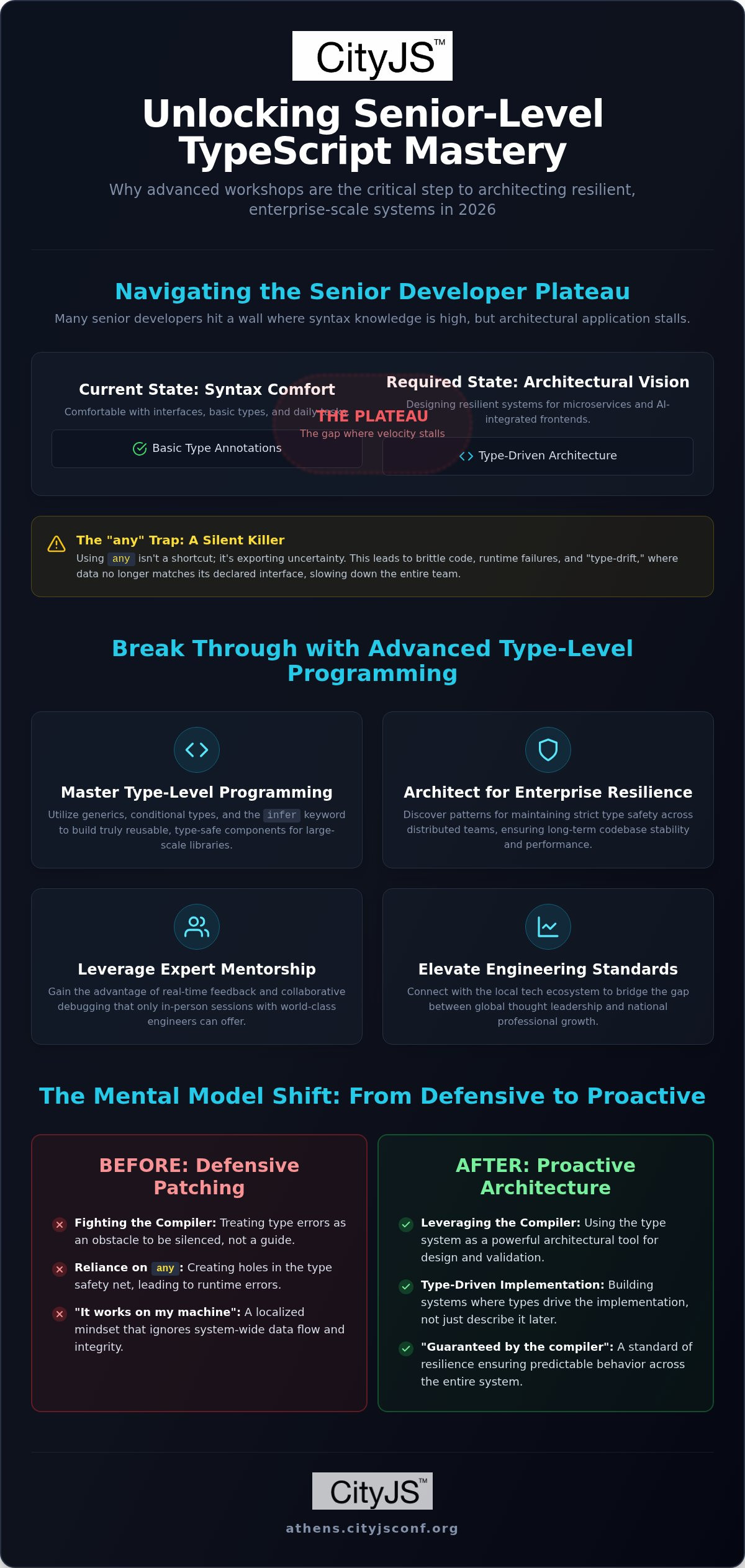
Many senior developers reach a point where their current knowledge of TypeScript feels sufficient for daily tasks but fails during high-stakes refactors. You're likely comfortable with interfaces and basic types, yet you find yourself fighting the compiler when implementing complex feature requirements. This is the Senior Plateau. It's that frustrating space where your syntax knowledge is high, but your architectural application hasn't caught up to the demands of enterprise-scale systems. In 2026, technical literacy isn't defined by knowing how to write a function. It's defined by how you handle data transformations across a microservices mesh or an AI-integrated frontend.
The "Any" Trap and Technical Debt
Relying on the "any" keyword is a silent killer in production-grade systems. It isn't just a temporary fix; it's a hole in your safety net that cascades into runtime failures. When a senior engineer uses "any" or "unknown" incorrectly, they aren't just saving time. They are exporting uncertainty to every other developer on the team. This uncertainty leads to "type-drift," where the actual runtime data looks nothing like the declared interfaces. We define the Senior Plateau as the gap between syntax knowledge and architectural application. Moving past this requires advanced TypeScript workshops that focus on transforming your mental model from defensive patching to proactive system design. Poor type safety slows down team velocity and extends code review cycles. Engineers lose hours trying to understand data flow without reliable definitions.
Engineering Resilience in 2026
Modern frameworks now demand sophisticated type-level programming to deliver a fluid developer experience. If you aren't architecting with types, you're likely falling behind modern frontend architecture trends that prioritize predictable data structures. This precision is vital for securing high-performance Node.js architecture. In the Greek tech market, meeting national engineering standards for software reliability means moving beyond simply using the language. You must learn to architect with it. Participating in advanced TypeScript workshops helps bridge this gap by providing practical, in-the-trenches experience. You'll learn to build systems where the types drive the implementation rather than just describing it after the fact. This transition ensures your applications remain resilient against the complexities of distributed engineering teams and high-stakes environments. It's about moving from a "it works on my machine" mentality to a "it's guaranteed by the compiler" standard.
Mastering Type-Level Programming: Generics, Conditional Types, and Beyond
Syntax is the floor. Architecture is the ceiling. Deepening your command over the TypeScript language means moving beyond surface-level annotations. You must learn to treat types as data that can be manipulated, mapped, and transformed. Our advanced TypeScript workshops move you past the basics of interfaces into the mechanics of conditional types and the infer keyword. These tools allow you to unlock type transformations that were previously impossible, such as extracting return types from complex functions or unwrapping nested promises automatically. We also explore template literal types, which enable you to create precise, string-based APIs for internal tooling. This ensures that even your most complex string patterns, like CSS-in-JS keys or route paths, are validated at compile time with absolute precision.
Assertion functions and type predicates provide the necessary link between unpredictable runtime data and rigorous type safety. By mastering these, you stop guessing what your data looks like and start proving it to the compiler. This is particularly vital when dealing with external APIs or legacy data structures where type definitions might be missing or incorrect. To see how these concepts apply to real-world projects, explore the upcoming workshop tracks at CityJS Athens. Mastering these patterns allows you to build a bridge between the Senior Plateau and true architectural mastery.
Advanced Generics and Type Transformations
Move beyond simple <T> definitions. High-performance engineering requires complex constraints and multi-parameter generic systems that can adapt to diverse inputs without losing specificity. You will learn to derive types directly from runtime constants using typeof and as const effectively. This technique ensures your types stay in sync with your actual data without manual updates, reducing the risk of stale type definitions. We focus on building custom utility types from scratch, such as:
- Deeply nested Pick and Omit variants for state management.
- Recursive Partial types for complex configuration objects.
- Discriminated union builders that automate boilerplate.
These are the building blocks of resilient, large-scale libraries that provide a world-class developer experience.
Diagnosing Complex Type Errors
Unblocking a deeply nested type error shouldn't feel like a game of trial and error. You need a systematic approach to understand the compiler’s mental model. By learning how the engine resolves intersections, unions, and distributive conditional types, you can predict and prevent errors before they occur. This knowledge also allows you to improve team-wide developer experience. Instead of leaving obscure error logs for your peers, you'll learn to author clearer, more helpful error messages that guide your colleagues toward a solution. This proactive approach to type design minimizes friction during code reviews and accelerates the entire development lifecycle. Ultimately, mastering these patterns is the primary focus of advanced TypeScript workshops designed for elite practitioners who want to lead their teams with technical authority.
Architecting for Scale: TypeScript Patterns for Enterprise Resilience
Enterprise resilience isn't accidental. It's engineered. For senior developers, the real challenge isn't writing a single component; it's ensuring that a system of hundreds of components remains predictable over years of iteration. Our advanced TypeScript workshops dive deep into the structural side of the language, moving beyond syntax to focus on module design and encapsulation. This is critical when navigating modern frontend architecture trends where micro-frontends and distributed teams are the norm. You must maintain strict type boundaries while allowing for the flexibility required in high-stakes environments. Brittle types lead to brittle systems. We focus on building the "in-the-trenches" skills needed to prevent architectural decay.
Integration with AI is the next frontier for professional growth. In 2026, staying relevant means understanding AI implementation for software teams. Advanced types serve as the guardrails for agentic workflows, ensuring that AI-generated code or data structures adhere to your system's core contracts. We also tackle performance. Large-scale projects often suffer from slow type-checking in CI/CD pipelines. We teach you to optimize your definitions so that the compiler aids your velocity rather than hindering it. This ensures your high-performance engineering standards aren't compromised by technical overhead.
Type Safety in Distributed Systems
Sharing types between frontend and backend shouldn't lead to circular dependency hell. We focus on contract-first development, a necessity for national-scale software projects in Greece. By utilizing monorepo structures and shared type libraries, you ensure that a change in the backend schema immediately notifies the frontend team. This prevents the "silent failures" that plague distributed systems. It's about creating a single source of truth that spans the entire stack. Proper encapsulation ensures that your internal implementation details don't leak into the public API, maintaining a clean separation of concerns and reducing the cognitive load on your engineering team.
Security and Validation Patterns
Validation is where your types meet the real world. Using tools like Zod allows you to enforce schema-first development, bridging the gap between raw API data and your internal type system. Type-level programming serves as the first line of defense in application security. By enforcing security protocols at the architectural level, you make it mathematically impossible to pass unvalidated data into sensitive logic. This proactive approach is a core focus of our advanced TypeScript workshops, where we prioritize real-world engineering resilience over abstract theory. You'll learn to author validation layers that are both performant and impossible to bypass, securing your enterprise applications from the ground up while providing an elite developer experience for your peers.
Tactical Learning: Why In-Person Workshops Outperform Self-Paced Tutorials
Solo screen-time has its limits. While video-based platforms offer bite-sized challenges, they often fail to address the psychological and professional benefits of physical presence. You can't ask a pre-recorded video to explain how a specific generic constraint affects your company's proprietary micro-frontend architecture. Advanced TypeScript workshops solve this by providing a high-stakes, peer-to-peer environment where collaborative debugging is the standard. Solving "in-the-trenches" problems with senior peers creates a level of technical immersion that is impossible to replicate at home. It shifts your focus from passive consumption to active, expert-led construction. This dedicated environment ensures that you master complex type-level programming without the constant interruptions of Slack notifications or household distractions.
Participating in these sessions also builds your professional prestige. It signals to the industry that you are committed to high-performance engineering at the highest level. By stepping away from the keyboard and into a room of like-minded experts, you gain a broader perspective on how global tech giants handle scale. This experience is vital for any developer looking to lead their team through the complexities of 2026. Secure your Professional Workshop seat at CityJS Athens to experience this high-impact learning first-hand.
The Power of Expert Mentorship
Hearing the "why" behind a pattern from a global speaker beats reading a README every time. Direct access to engineering leaders like Kyle Simpson and Tejas Kumar allows you to tailor the learning experience to your specific national market challenges. These mentors don't just teach syntax; they share the decision-making frameworks used at the highest levels of software architecture. This real-time feedback loop allows you to correct subtle misconceptions in your mental model before they become expensive mistakes in production. It's a "no-nonsense" advantage that self-paced tutorials simply cannot match. You leave not just with new knowledge, but with the confidence to apply it immediately.
Networking as Professional Growth
Physical meetups accelerate senior career growth by allowing you to exchange "war stories" that never make it into public tutorials. You aren't just learning; you are building lasting bonds within the software engineering community. This social connector aspect is invaluable for discovering how other elite teams in Greece are tackling similar architectural hurdles. These informal conversations often provide the most practical, "in-the-trenches" insights. Forming these connections with the national engineering elite ensures you stay at the forefront of the industry, creating a support network of peers that lasts long after the workshop concludes. Beyond the screen, these relationships become the foundation for future collaborations and career opportunities.
Elevating National Engineering Standards: The CityJS Athens Workshop Experience
CityJS Athens has established itself as the premier hub for high-level technical training in Greece. It isn't just a series of talks; it's a meticulously curated environment designed to bridge the gap between global thought leadership and local engineering excellence. For the senior developer, these advanced TypeScript workshops represent the highest standard of professional development available in the country. We don't settle for introductory content. Instead, we provide the "in-the-trenches" knowledge required to lead modern software teams through the complexities of enterprise-scale architecture. This event serves as a bridge, connecting you with the same icons who define the standards used at global tech giants.
Securing CityJS Athens tickets is more than a line item in a training budget. It's a calculated investment in your team's ROI. By sending your lead engineers to these sessions, you ensure your organization avoids the costly technical debt associated with brittle type definitions and architectural decay. You are investing in the collective intelligence of the national tech ecosystem. This ensures that Greek engineering standards remain competitive on a global scale. In an industry that moves as fast as ours, being in the room where these conversations happen is the only way to stay ahead of the curve.
What to Expect in a CityJS Masterclass
The 2026 curriculum is built for immediate impact. It moves logically from "type magic" techniques to the hard requirements of enterprise-scale resilience. You'll work in central national venues, such as the Athens War Museum between October 21 and 23, providing a professional backdrop for deep technical focus and high-level networking. Preparation is straightforward but essential. We ensure your team is ready for production-grade AI and TS integration by providing prerequisites well in advance. This isn't a passive experience. It's a hands-on summit where you'll solve real-world problems alongside the industry's most respected icons, ensuring your skills are relevant for the TypeScript 7.0 era.
Securing Your Professional Legacy
Elite practitioners understand that their career growth depends on continuous immersion in complex topics. Participating in advanced TypeScript workshops contributes to your long-term professional legacy, positioning you as a knowledgeable guide within your own organization. You aren't just learning a tool; you're mastering a craft that defines the future of software reliability. The next step is clear. Join the 2026 engineering summit to secure your place among the national engineering elite. Registration is open, and the opportunity to network with global leaders in the heart of Athens is an experience that will resonate throughout your entire career. Don't let your skills plateau when the next level of architectural mastery is within reach.
Master the Future of Enterprise Architecture
The transition from a senior developer to an elite architect requires a fundamental shift in perspective. It's about moving beyond basic annotations to master the complex type-level programming that ensures long-term system resilience. By participating in advanced TypeScript workshops, you stop fighting the compiler and start using it as a sophisticated tool for high-performance engineering. You've seen how these patterns secure distributed systems and prepare your team for the agentic workflows of 2026. This isn't just about syntax; it's about building the architectural guardrails that allow your organization to scale without fear.
Now is the time to secure your professional legacy. These deep-dive sessions are led by industry icons like Kyle Simpson and Maximilian Schwarzmüller, offering a no-nonsense approach to enterprise-grade engineering. As part of the globally recognized CityJS network, we bridge the gap between global thought leadership and local expertise right here in Athens. Don't let your development velocity stall under the weight of brittle types. Secure your spot at the 2026 Advanced TypeScript Workshops and join a community dedicated to collective growth. We look forward to seeing you at the Athens War Museum for this transformative experience.
Frequently Asked Questions
What are the prerequisites for attending an advanced TypeScript workshop?
You should have at least two years of professional experience using the language in production environments. We assume you're already comfortable with basic interfaces, unions, and intersection types. These advanced TypeScript workshops are specifically designed for senior engineers who need to bridge the gap between syntax knowledge and architectural application. If you're still learning the basics of type annotations, we recommend our community sessions first.
How do advanced TypeScript workshops differ from standard online bootcamps?
Our workshops provide real-time feedback from world-class mentors that pre-recorded videos simply can't match. Unlike standard bootcamps that follow a generic curriculum, these sessions focus on solving "in-the-trenches" problems with senior peers. You get direct access to engineering leaders who share decision-making frameworks used at global tech giants. It's a high-stakes environment where collaborative debugging and technical immersion take precedence over passive consumption.
Will the 2026 workshops cover TypeScript integration with AI and LLMs?
Yes, the 2026 curriculum specifically addresses the intersection of JavaScript, AI, and agentic systems. You'll learn to author type-safe guardrails that ensure AI-generated data structures adhere to your core system contracts. This is essential for maintaining software reliability as agentic workflows become standard. We focus on using the compiler to validate unpredictable runtime data from LLMs, ensuring your high-performance engineering standards aren't compromised.
Can I attend the workshops if I am a backend-focused Node.js engineer?
Backend-focused engineers will find immense value in our tracks dedicated to distributed systems and Node.js. We cover sharing types between frontend and backend without creating circular dependencies and enforcing security protocols at the architectural level. These advanced TypeScript workshops prioritize contract-first development, which is a necessity for any Node.js developer building national-scale software projects in Greece. Type safety is just as critical in the server-side mesh.
Are there group discounts for engineering teams attending the national summit?
Group tickets are available for engineering teams looking to invest in their collective intelligence. We offer specific pricing for groups starting from €342, allowing multiple senior developers from the same organization to attend together. This is a strategic way to ensure your entire lead engineering team masters the same high-performance patterns. It's an investment in team ROI that prevents architectural decay and improves development velocity across your entire department.
What kind of real-world projects will we work on during the advanced sessions?
You will work on building robust, reusable utility types and enterprise-grade library patterns from scratch. We move beyond simple generic constraints to master recursive types and complex transformations required for large-scale state management. These projects are modeled after "in-the-trenches" scenarios found in high-stakes production environments. You'll leave with practical code samples and mental models that you can apply immediately to your own company's codebase.
Is there a certificate of completion for professional development tracking?
We provide a certificate of completion that serves as a tangible record of your professional development. This document is valuable for tracking your career growth and securing your professional legacy within the Greek tech ecosystem. It signals to current and future employers that you have mastered the elite architectural patterns required for senior leadership. Beyond the certificate, the memories and networking bonds formed here provide lasting professional value.
How do these workshops align with current modern frontend architecture trends?
Our curriculum is directly aligned with modern frontend architecture trends like micro-frontends and micro-services. We focus on maintaining strict type boundaries while allowing the flexibility required for distributed teams. By mastering advanced type-level programming, you ensure that your frontend components remain predictable and resilient as your system scales. This approach reduces cognitive load and provides a world-class developer experience for everyone on your engineering team.


