
Leading a high-performance team in 2026 isn't about leaving your IDE behind; it's about mastering the architecture of people with the same precision you apply to a distributed system. You've spent years honing your craft, yet the transition to management often feels like a step toward technical obsolescence. Finding relevant engineering leadership training Greece can be difficult when most generic seminars fail to address the "in-the-trenches" reality of scaling a local tech team or navigating the complexities of Law 5321/2026. You need a path that respects your expertise while equipping you for the strategic demands of a competitive national market.
This article provides the definitive roadmap for professional growth, designed specifically for practitioners who refuse to choose between technical depth and management excellence. You'll learn how to master the transition from senior contributor to strategic leader using frameworks tailored for the local ecosystem. We'll preview the essential skills for managing technical debt alongside AI integration, the value of peer networking with national industry peers, and how to identify credible, expert-led training that moves the needle for your career and your team.
Key Takeaways
- Redefine your role as a hybrid of technical strategy and organizational design to navigate the specific challenges of the 2026 Greek tech market.
- Master the pillars of modern management by integrating AI governance and Law 5321/2026 compliance directly into your team's engineering roadmap.
- Identify the highest ROI path for your career by comparing traditional academic degrees with specialized engineering leadership training Greece led by global practitioners.
- Apply actionable frameworks to audit technical bottlenecks and establish internal mentorship programs that scale engineering culture without losing velocity.
- Leverage the national networking hub at CityJS Athens 2026 to gain "in-the-trenches" insights from industry leaders and local peers.
Beyond the Senior Developer: The New Engineering Leadership Landscape in Greece
Engineering leadership is no longer just a reward for years spent shipping features. It is a distinct, high-stakes discipline that blends technical strategy with organizational design. In the 2026 Greek market, where the competition for elite talent is relentless, a leader doesn't just manage people; they architect environments where technical excellence can thrive. This shift requires engineering leadership training Greece can actually benefit from, moving beyond generic corporate advice to address the specific friction points of a modern software stack. While foundational leadership development principles provide a useful baseline, they often lack the technical nuance required to manage a complex CI/CD pipeline or a distributed team.
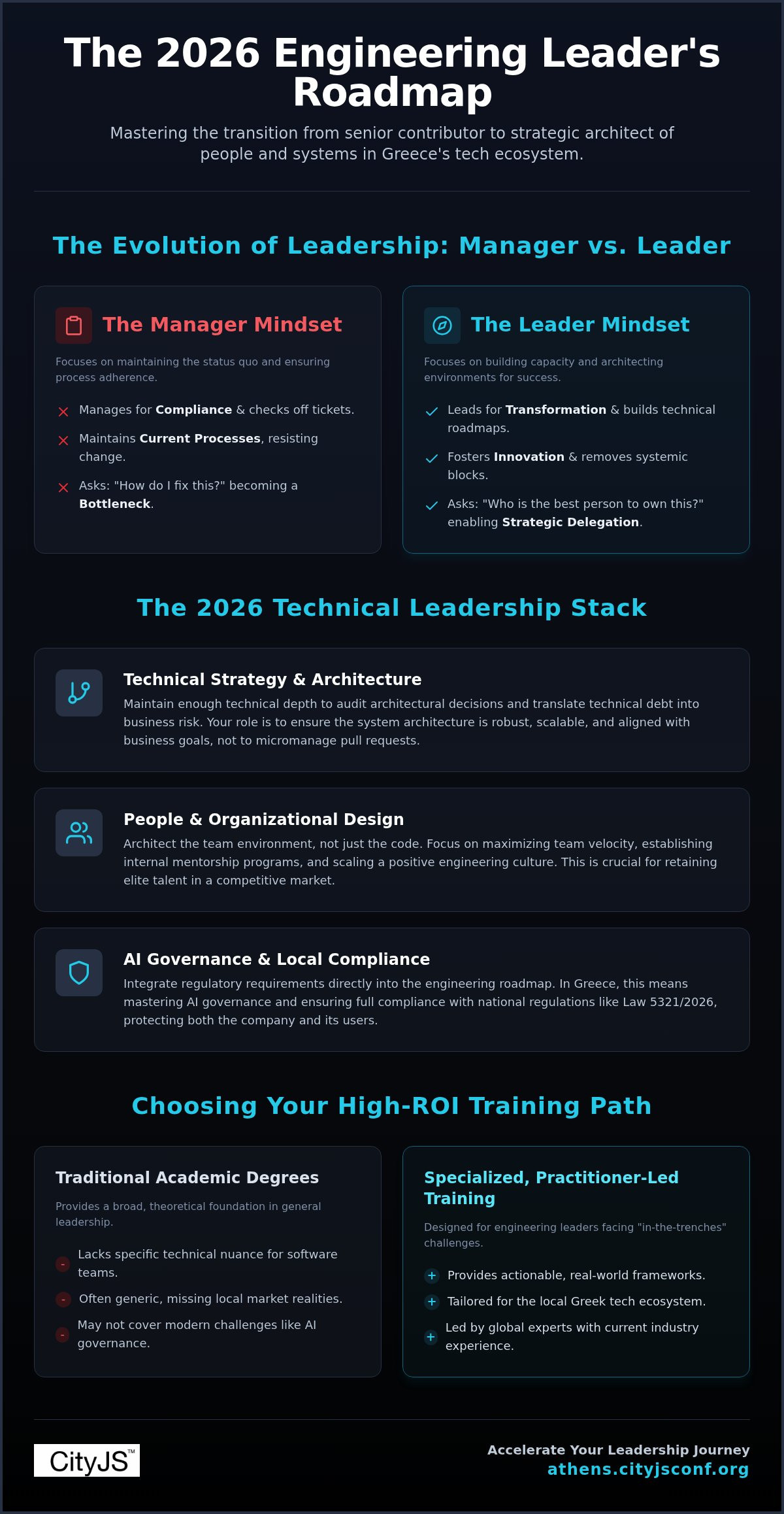
The distinction between a manager and a leader is binary in a high-velocity environment. Managers focus on compliance, maintaining current processes, and checking off tickets. Leaders focus on transformation, building technical roadmaps, and fostering innovation. Traditional management training often fails technical practitioners because it ignores the reality of technical debt, deployment cycles, and the unique psychology of engineers. You don't need to learn how to fill out spreadsheets; you need to learn how to lead through complexity.
The Evolution of the Technical Lead Role
Your responsibilities are shifting from individual execution to systemic oversight. You aren't just writing code; you're ensuring your team maintains a high-performance Node.js architecture that can scale with the business. This evolution requires a delicate balance. If you step too far away from the code, you lose "in-the-trenches" credibility. If you stay too close, you become a bottleneck. Successful leaders in 2026 prioritize the following:
- Technical Literacy: Maintaining enough depth to audit architectural decisions without micromanaging.
- Team Velocity: Identifying and removing the systemic blocks that slow down senior contributors.
- Strategic Delegation: Moving from "how do I fix this?" to "who is the best person to own this?".
Why National Tech Teams Require Specialized Guidance
Scaling a team in Greece involves navigating a specific professional ecosystem. With the full implementation of Law 5321/2026, engineering leaders must now integrate AI governance and compliance into their daily workflows while managing the expectations of a global market. Building a robust software engineering community within your organization is the only way to retain senior talent who are constantly being scouted by international firms. Specialized engineering leadership training Greece offers should focus on these local realities, providing pragmatic frameworks for cultural scaling and technical governance that generic global courses simply miss.
The 2026 Technical Leadership Stack: Architecture, People, and AI Governance
The 2026 technical leadership stack isn't a static set of soft skills. It's a dynamic integration of system design, human capital, and regulatory compliance. To excel, you need engineering leadership training Greece provides that goes beyond abstract theory; you need practitioner-led insights that survive real-world deployment. Mastering modern engineering leadership means moving beyond managing tasks to managing the cognitive load of your entire department. You're responsible for the architecture of the code and the architecture of the team.
Effective leaders maintain their "in-the-trenches" experience to bridge the gap between high-level business goals and ground-level implementation. This doesn't mean writing every PR, but it does mean understanding the friction your developers face. Communication for cross-functional alignment becomes your primary tool. You must translate technical debt into business risk and architectural wins into competitive advantages. Without this translation layer, engineering teams often become siloed, losing the ability to influence the broader company direction.
Strategic Architecture and Technical Debt
Leaders must evaluate modern frontend architecture trends not just for performance, but for maintainability at enterprise scale. You're no longer just picking a library. You're making high-stakes "buy vs. build" decisions that impact the company's bottom line for years. Sustainable growth requires a framework for technical debt that doesn't halt the roadmap. High-level leaders create a culture where refactoring is a scheduled priority, not a hidden crime. This ensures that the system remains agile enough to pivot when market conditions change without requiring a total rewrite.
AI Implementation and Governance for Leaders
The future of AI implementation for software teams involves more than just giving everyone a chatbot. As of August 2026, the Hellenic Data Protection Authority enforces strict real-world testing for high-risk AI systems under Law 5321/2026. Leaders must establish agentic workflows that enhance productivity without compromising security or eroding core engineering skills. It's about training your team to be "AI-augmented" rather than "AI-dependent," ensuring that architectural integrity remains a human-led priority.
Balancing these technical and regulatory pillars requires a level of sophistication that generic project management courses can't offer. If you're looking to sharpen these specific technical management skills, consider exploring the professional workshop tracks at upcoming industry summits. This specialized engineering leadership training Greece empowers you to build resilient systems and high-performing teams simultaneously.
Evaluating Training Models: From MSc Degrees to Expert-Led Professional Workshops
Choosing the right path for professional growth in 2026 requires a cold calculation of time versus utility. For a senior developer, the traditional route often involves a multi-year Master’s degree. While an MSc in Engineering & Technology in Greece typically costs around €3,250, the real cost is the two-year commitment in a market that moves in weeks. You don't just need a credential; you need engineering leadership training Greece provides that translates directly to your current sprint. High-level practitioners are increasingly pivoting toward intensive, expert-led workshops that offer immediate application over abstract academic theory.
The ROI of training is measured by how quickly you can implement a new framework or solve a systemic bottleneck. Learning business engineering skills from a textbook is one thing; learning them from a CTO who has scaled global platforms is another. Practitioner-led training filters out the noise. It focuses on the "in-the-trenches" realities of 2026, such as managing distributed teams under Law 5321/2026 or optimizing agentic workflows. These masterclasses provide a level of depth that generalist corporate seminars simply cannot reach.
The Academic vs. Practitioner Debate
Academic programs, such as MSc degrees in Leadership offered by prominent national universities, costing €12,000, provide a prestigious foundation for those seeking political or ethical deep dives. However, for the technical lead, these programs often move too slowly. Professional masterclasses are the pragmatic alternative. They offer a "Deep Dive" into specific leadership archetypes. Learning from industry legends like Kyle Simpson or Tejas Kumar provides insights that haven't even hit the textbooks yet. You gain the confidence of an industry leader by learning from those who are currently defining the industry.
Maximizing Training ROI for Engineering Teams
Training shouldn't be a solitary journey. Forward-thinking companies are using tech conference sponsorship to upskill entire departments simultaneously. This approach turns a single educational event into a collective cultural shift. When budgeting for 2026, consider the networking ROI of in-person national summits. Meeting your peers at key professional gatherings provides a social connector that online-only courses lack. Success is ultimately measured through team retention. Engineers stay where they grow, and providing access to elite engineering leadership training Greece is the most effective way to signal that your organization values technical mastery as much as management.
Scaling Your Team: Practical Frameworks for National Tech Leaders
Scaling a technical organization in the competitive 2026 Greek market requires more than just aggressive hiring; it demands a systematic approach to team architecture. You cannot build a high-velocity culture on top of unaddressed technical debt or opaque career paths. Elite engineering leadership training Greece emphasizes that the first step is always a rigorous audit of your current bottlenecks. Are your sprint cycles stalling at the peer review stage? Is your CI/CD pipeline brittle? Identifying these friction points allows you to move from reactive firefighting to proactive leadership. By focusing on the systemic causes of delay, you empower your senior contributors to spend more time on innovation and less on maintenance.
Building a resilient team also means establishing a "No-Blame" culture for incident response. When a deployment fails or an AI agentic workflow behaves unexpectedly, the focus must remain on systemic improvement rather than individual fault. This psychological safety is the foundation of high-performance teams. It ensures that developers feel empowered to innovate without the paralyzing fear of a single mistake ending their career. Standardizing these professional development paths ensures every engineer knows exactly how to reach the next level of technical or managerial mastery. This clarity is a powerful retention tool in a national market where top talent is constantly scouted by international firms.
Cultivating this resilient mindset involves understanding the core principles of motivation and mental wellness; to explore how experts like Jeff Yalden approach these topics, read more.
Mentorship and Career Pathing
Effective mentorship isn't a vague coffee chat; it's a structured investment in technical excellence. Implementing internal "guilds" allows your team to share knowledge across different projects, fostering a sense of shared ownership and community. This is particularly vital for retention in the local ecosystem. You must provide clear paths for growth that don't force every talented coder into a management role. Some of your best contributors should remain Individual Contributors (ICs) with the influence and salary of a director. This ensures you don't lose your most brilliant technical minds to administrative overhead while still providing them with a clear trajectory for professional ambition.
Operational Excellence in 2026
Operational Excellence is the balance between speed and reliability. Achieving this requires modernizing your code review and deployment lifecycle to handle the complexities of hybrid and remote work within Greece. As national teams become more distributed, your communication frameworks must become more explicit. You need tools and processes that maintain visibility without resorting to micromanagement. By focusing on these pragmatic frameworks, you create an environment that attracts and retains the country's top engineering talent. To dive deeper into these scaling strategies with global experts, explore the professional workshops at CityJS Athens.
Accelerating Your Leadership Journey at CityJS Athens 2026
Theory alone won't bridge the gap between senior contributor and strategic leader. Real growth happens at the intersection of expert-led instruction and high-level peer exchange. CityJS Athens 2026 serves as the primary catalyst for this transition, offering a concentrated dose of engineering leadership training Greece that is simply unavailable through traditional corporate channels. By stepping out of your daily sprint and into the Athens War Museum this October, you align your technical roadmap with the global standards set by industry pioneers. Meeting global thought leaders in person changes your perspective; it humanizes the complex architectural shifts you've been navigating in isolation.
The summit is designed to be a "social connector" for the national tech scene. You aren't just attending lectures; you're engaging with peer CTOs and Engineering Leads who face the same scaling challenges within the Greek ecosystem. These interactions provide a unique filter, helping you distinguish between global hype and local applicability. To ensure your seat at this elite gathering, you should secure your CityJS Athens 2026 tickets early, as professional tracks for leadership often reach capacity months before the event.
Professional Workshops for Senior Engineers
The 2026 professional workshops go far beyond surface-level tutorials. Expect deep dives into agentic AI workflows, high-performance Node.js architecture, and the intricacies of system-wide design. These sessions provide hands-on training that translates directly to your production environment, allowing you to return to your team with immediately actionable frameworks. Exclusive leadership-focused sessions facilitate deep-dive discussions on technical governance and team velocity, ensuring you gain technical mastery and strategic clarity simultaneously. You'll learn from practitioners like Kyle Simpson and Tejas Kumar, experts who have built at a scale most only read about in documentation.
Joining the National Engineering Elite
Success in the national market depends heavily on your professional network. CityJS Athens allows you to build long-term relationships with the architects and directors shaping the future of Greek technology. This is your opportunity to position yourself as a thought leader within the community, contributing to the collective growth of the ecosystem while accelerating your own career trajectory. Don't leave your professional development to chance. Register for professional training at CityJS Athens 2026 today and secure your place among the next generation of engineering leaders.
Building the Future of Greek Engineering Leadership
The transition from a senior contributor to a strategic leader is the most significant pivot in a technical career. It requires a shift from mastering syntax to mastering the architecture of teams and the complexities of AI governance. By adopting pragmatic frameworks for technical debt and team scaling, you ensure your organization remains resilient in a competitive national market. Seeking out specialized engineering leadership training Greece offers is no longer optional for those aiming to influence the next decade of innovation. You need "in-the-trenches" insights that academic degrees simply can't deliver at the pace of modern software development.
CityJS Athens 2026 provides the elite environment needed to bridge this gap. With global expert speakers from major tech hubs and specialized workshops for senior roles, you'll gain the technical and strategic depth required to lead with confidence. This is your hub for national networking with industry decision-makers who are shaping the local ecosystem. Don't let your professional growth stall in the face of rapid industry shifts. Master your leadership journey: Get CityJS Athens 2026 Professional Workshop Tickets. Your path toward technical and organizational mastery starts here.
Frequently Asked Questions
What is the best way to start engineering leadership training in Greece?
Start by identifying the specific friction points in your current team's delivery cycle. Practical engineering leadership training Greece often begins with practitioner-led workshops that focus on immediate architectural and organizational bottlenecks. Rather than pursuing a generic management certificate, seek out masterclasses that address the technical and regulatory realities of the 2026 Greek market. This hands-on approach ensures your transition from individual contributor to strategic leader is grounded in real-world application.
Can I attend engineering management workshops without a computer science degree?
Yes, you can attend engineering management workshops without a computer science degree. Professional development in 2026 prioritizes "in-the-trenches" experience and technical literacy over academic credentials. Most advanced workshops focus on systems design, AI governance, and people architecture; these are skills often acquired through years of senior-level individual contribution. Your ability to lead depends on your current technical mastery and strategic mindset rather than your undergraduate history.
How does CityJS Athens 2026 compare to traditional corporate leadership training?
CityJS Athens 2026 replaces abstract theory with practitioner-led frameworks designed for high-velocity tech environments. While traditional corporate training focuses on generic soft skills, our summit provides specialized deep dives into technical strategy and team velocity. You'll learn from global experts who have scaled systems at tech giants, providing a level of technical nuance that generalist management seminars cannot match. It's a pragmatic alternative to the slower pace of academic leadership paths.
Are there professional development grants for engineering training in 2026?
Professional development grants for engineering training in 2026 are often available through EU-funded digital transformation initiatives and national upskilling programs. Many Greek tech firms also leverage LAEK funds to subsidize employee workshops. Check with your HR department regarding current eligibility for these subsidies. These programs specifically target technical leadership and AI integration skills to bolster national competitiveness in the European tech sector, making elite engineering leadership training Greece more accessible.
What are the core skills needed for engineering management in a JavaScript-heavy team?
Managing a JavaScript-heavy team requires a balance of architectural oversight and operational reliability. You must master asynchronous system design, high-performance Node.js architecture, and the implementation of agentic AI workflows. Beyond the code, core skills include managing technical debt without halting the roadmap and fostering a "No-Blame" culture during incident response. These competencies ensure your team remains agile while maintaining the high standards required for enterprise-scale deployments in 2026.
Is in-person leadership training better than online courses for senior devs?
In-person training offers superior networking ROI and deeper engagement for senior developers. While online courses provide convenience, they lack the "social connector" aspect of national summits. Meeting peer CTOs and leads in person at the Athens War Museum facilitates high-level peer exchange that rarely happens in a digital format. These physical gatherings allow for nuanced discussions on local regulations and market conditions that are essential for effective leadership.
How can I convince my company to sponsor my engineering leadership training?
Frame the training as an investment in team retention and operational efficiency. Explain how specialized leadership workshops will help you audit technical bottlenecks and implement mentorship programs that reduce turnover. Highlight the specific value of learning AI governance under Law 5321/2026, which is a critical compliance requirement for the business. Positioning the training as a way to accelerate delivery and ensure legal compliance makes the sponsorship decision a clear business win.


