

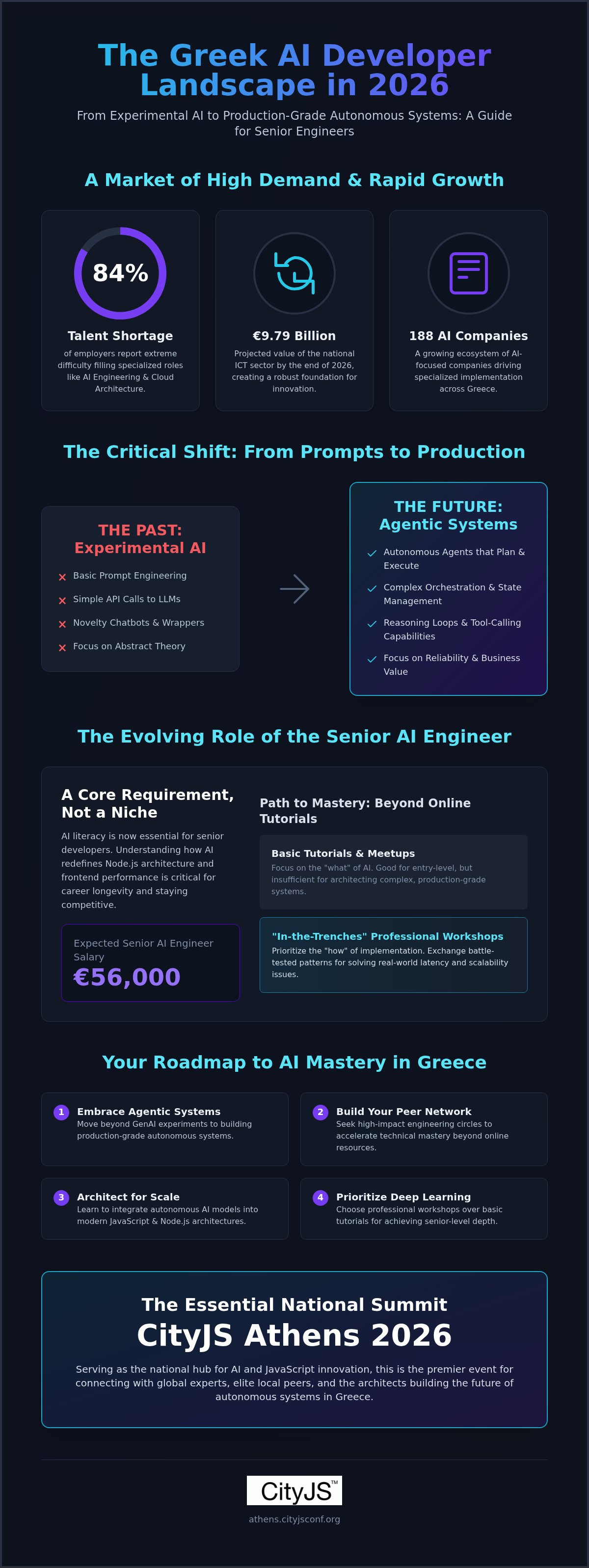
84% of Greek employers report extreme difficulty filling specialized roles in AI engineering and cloud architecture. This statistic highlights a critical reality for the AI developer community Greece. While the national ICT sector is projected to reach a value of €9.79 billion by the end of 2026, the real challenge isn't the growth of the market. It's the depth of expertise. You've likely experienced the exhaustion of navigating information overload, where high-level architectural insights are often buried under basic coding tutorials.
It's time to bridge the gap between academic theory and production-grade reality. We agree that the national ecosystem needs more than just networking; it requires a structured environment for senior-level exchange. This guide promises to help you navigate the evolving national landscape, from the implementation of Law 5321/2026 to the arrival of the DAEDALUS supercomputer. We'll preview the essential professional workshops and elite networking opportunities, such as CityJS Athens 2026, that will empower you to master agentic workflows and autonomous systems alongside your most ambitious peers.
Key Takeaways
- Understand the critical shift from experimental GenAI to production-grade agentic systems within the AI developer community Greece.
- Identify high-impact engineering circles and peer-to-peer networking strategies that accelerate technical mastery beyond standard online resources.
- Learn how to architect scalable, mission-critical systems by integrating autonomous AI models into modern JavaScript and Node.js architectures.
- Evaluate the benefits of "in-the-trenches" professional workshops over basic tutorials for achieving senior-level engineering depth.
- Discover how CityJS Athens 2026 serves as the essential national summit for connecting with global experts and elite local peers.
The Evolution of the AI Developer Landscape in Greece
The year 2026 marks a definitive pivot for the AI developer community Greece. We've moved past the era of novelty chatbots and experimental wrappers. Today, the focus has shifted toward production-grade engineering that delivers measurable business value. Greece is uniquely positioned for this integration. With 188 AI-focused companies and a projected ICT sector value of €9.79 billion by the end of the year, the infrastructure for innovation is solid. This growth is anchored by institutions like the Foundation for Research & Technology - Hellas (FORTH), which continues to set high standards for local research and development. The national scene is no longer just a participant in the global conversation; it's a hub for specialized implementation.
From Prompt Engineering to Agentic Workflows
Simple API calls to Large Language Models are no longer sufficient for enterprise-grade applications. The industry has matured. We're now seeing the rise of autonomous agents that can plan, execute, and self-correct within national software projects. These agentic workflows require a deep understanding of state management and complex orchestration. Leading teams are moving away from basic prompt engineering toward building systems that leverage reasoning loops and tool-calling capabilities. This shift demands a "no-nonsense" approach to system design. Reliability is now the primary metric for success in production environments, forcing developers to master the nuances of agentic autonomy. To see how these principles are applied in high-stakes sectors like aviation, you can discover Assaia and their work in AI-driven apron optimization solutions.
The Growing Demand for AI-Literate Senior Engineers
The role of the AI Engineer has evolved into a core requirement for modern software teams. It's no longer a niche specialization. Senior developers must now understand how AI redefines Node.js architecture and frontend performance. This transition is reflected in current market data. As of August 2026, senior AI engineers in Greece can expect salaries reaching €56,000, which reflects the acute talent shortage reported by 84% of employers. Staying competitive within the AI developer community Greece requires a commitment to continuous professional growth. Many practitioners are seeking advanced AI developer training programs Greece that prioritize "in-the-trenches" implementation over abstract theory. Global thought leadership is now a local standard. We see this in how international engineering standards are being adopted across Athens and Thessaloniki. High-level practitioners are no longer just consumers of technology; they are architects of autonomous systems that serve the prosperity of society, as outlined in the recent constitutional amendments regarding AI. This maturity is driving the need for a more connected and sophisticated local ecosystem.
Navigating the National AI Engineering Ecosystem
Technical mastery in the AI developer community Greece isn't built in isolation. While digital documentation provides the syntax, elite engineering peers provide the strategy. The national landscape has matured significantly following the rollout of Greece's National AI Strategy. This blueprint has catalyzed a shift from scattered hobbyist groups to high-impact technical circles focused on production-grade infrastructure. Navigating this ecosystem requires a move beyond passive consumption toward active, peer-driven exchange. It's about finding the "in-the-trenches" innovators who are solving real-world latency and scalability issues.
Building a Network of Senior Engineering Peers
Entry-level meetups often focus on the "what" of AI, but senior practitioners need to discuss the "how" of architectural implementation. To sustain career longevity, you must identify spaces where complex system design is the primary language. Engaging with the software engineering community Athens offers a path to connect with architects who are currently deploying autonomous systems into regulated environments. These circles provide a filter for the noise of global hype, focusing instead on the practical constraints of the Greek market. Peer-to-peer networking remains the fastest route to technical mastery because it allows for the immediate exchange of battle-tested patterns. You'll find that the most resilient systems in Athens aren't built by individuals, but by collectives of senior peers who share insights on security, scalability, and local compliance.
Collaborative Learning and Knowledge Exchange
The most valuable insights often come from production failures rather than polished success stories. Within the AI developer community Greece, a "no-nonsense" culture is emerging among lead engineers. This involves sharing the specific friction points of integrating LLMs with legacy Node.js environments or the latency challenges of agentic workflows. In-person interaction at national summits accelerates problem-solving in ways that asynchronous chat cannot match. When you're standing in a room with the creators of the national AI registry or lead developers from the 188 active AI firms in Greece, the barrier to high-level mentorship drops. You aren't just learning a framework; you're inheriting a methodology for scaling systems. Contributing to local open-source projects or participating in technical workshops is the best way to secure your place in these leadership circles. If you're looking to meet these elite peers, securing a Conference Day Pass for upcoming national summits is a strategic first step toward professional-grade networking. These events serve as the physical hub for the ecosystem, where the next generation of autonomous systems is architected through shared experience and rigorous debate.
Moving from Theoretical AI to Production-Grade Implementation
Is AI ready for mission-critical applications? This is the primary question facing the AI developer community Greece in late 2026. The answer isn't found in a marketing brochure; it's found in architectural rigor. Moving from a prototype to a production environment requires a departure from basic prompt loops toward robust, scalable systems that can handle real-world traffic. In Greece, where 83% of companies have increased AI adoption over the past year, the pressure to deliver reliable results is immense. This transition demands a deep integration of high-performance Node.js architecture with machine learning workflows to manage the asynchronous nature of model responses without sacrificing system stability. Enterprise-grade AI also means navigating local regulations. With Law 5321/2026 now in effect, engineers must ensure that national enterprise data remains secure and compliant with the Hellenic Data Protection Authority (HDPA) standards.
Production Challenges for AI-Integrated Systems
Managing the non-deterministic nature of AI is the greatest hurdle for senior engineers today. Production systems must account for latency spikes and the rising costs of token consumption that can quickly erode a project's budget. Observability isn't just about server logs anymore; it's about tracking model drift and hallucination rates in real-time. We need systems that don't just fail gracefully but provide clear pathways for human-in-the-loop intervention. Agentic reliability is the consistent delivery of verifiable, safe, and contextually accurate outputs from autonomous systems under varying production loads. Achieving this requires rigorous testing frameworks that simulate the unpredictability of agentic responses before they ever reach the end-user.
Infrastructure for the Modern AI Stack
The modern AI stack requires a specialized infrastructure that goes beyond traditional relational databases. Vector databases have become a standard requirement for retrieval-augmented generation (RAG) patterns, enabling systems to query vast datasets with semantic precision. Orchestration tools must be carefully selected to manage state across complex agentic chains, especially as we begin to leverage the DAEDALUS supercomputer for high-performance computing tasks. Additionally, modern frontend architecture trends are shifting to support streaming responses and AI-driven interfaces that feel instantaneous. Optimizing the frontend for these interactions is critical. It's not just about the model's speed; it's about how the user perceives the intelligence of the system through a seamless, low-latency interface.
Strategic Professional Development for AI Engineers
Online tutorials are excellent for learning syntax, but they frequently fail when it comes to complex system architecture. For the AI developer community Greece, the challenge in 2026 isn't a lack of information. It's a lack of high-level, peer-to-peer technical training. Given the acute shortage of senior practitioners in the national market, the demand for verified expertise has never been higher. You can't master agentic workflows or non-deterministic systems by simply watching a screen. True mastery requires a "no-nonsense" approach that involves breaking code in real-time alongside elite peers. In-person sessions allow you to explore the edge cases that documentation ignores.
High-Impact Workshops and Masterclasses
Evaluating workshop quality requires looking beyond the syllabus. You need to assess the expert pedigree and the depth of the technical challenges presented. Learning from "in-the-trenches" practitioners like Kyle Simpson provides insights that are impossible to find in basic bootcamps. These sessions prioritize immediate practical application over abstract theory. A professional roadmap for 2026 must include hands-on coding that addresses the friction points of integrating AI into existing JavaScript stacks. You'll move faster when you can ask direct questions to global thought leaders who have already solved the latency and cost issues you're currently facing.
Key elements of a high-value technical workshop include:
- Expert Pedigree: Instruction led by engineers who have deployed production-grade AI at scale.
- Architectural Focus: Moving beyond API calls to discuss state management and orchestration.
- Peer Interaction: Collaborative problem-solving with other senior-level practitioners.
- Immediate ROI: Code and strategies that can be implemented in your current projects the next day.
Engineering Leadership and Continuous Growth
CTOs and engineering leads play a vital role in addressing these talent shortages. Fostering an AI-first culture isn't just about adopting new tools; it's about investing in the collective growth of the team. Maintaining a competitive edge within the AI developer community Greece requires a commitment to high-level training and peer exchange. Sending your engineers to national technical summits offers a significant ROI through improved retention and faster development cycles. You aren't just buying a ticket. You're securing the future of your architecture. To ensure your team is prepared for the next wave of autonomous systems, you should consider enrolling them in professional workshops that focus on real-world implementation. This commitment to continuous growth is what separates the leaders from the laggards in the current market.
CityJS Athens: The National Hub for AI and JavaScript Innovation
CityJS Athens 2026 is the physical epicenter for the AI developer community Greece. From October 21-23 at the Athens War Museum, this summit facilitates the vital convergence of JavaScript architecture and production-grade AI. We're moving beyond digital isolation. While online platforms provide the "what," our national summit provides the "how" through shared professional journeys and rigorous technical exchange. Human connection remains the most powerful tool in a digital-first industry. This is where the national ecosystem finds its voice and its future.
Expert-Led Training and Networking
The summit features intensive Professional Workshops led by global authorities like Kyle Simpson and Tejas Kumar. These aren't introductory sessions. We focus on "in-the-trenches" engineering, diving into advanced Node.js integration and the orchestration of agentic workflows. You'll network with the national elite, including lead developers from Greece's 188 AI-focused companies. CityJS serves as a curator. It filters out the hype to provide high-impact information that senior engineers can implement immediately. By bridging the gap between global thought leaders and local practitioners, we ensure that Greek engineering standards remain world-class.
Securing Your Place in the Community
Engagement is a strategic investment in your professional future. For senior practitioners, CityJS Athens tickets offer access to the most sophisticated technical discourse in the country. Organizations can leverage our Sponsorship Packages to position themselves at the heart of the national AI transformation. Whether you're utilizing a Conference Day Pass for the main tracks or attending our Free Community Workshops, your presence strengthens the entire ecosystem. The talent shortage is real, but the solutions are found here. Don't just watch the evolution from the sidelines. Join the leaders of the AI developer community Greece this October to architect the next wave of autonomous systems and secure your place in the national engineering elite.
Architecting the Future of Greek Engineering
The transition from experimental prototypes to mission-critical autonomous systems is no longer a distant goal. It's a current requirement for any senior practitioner. We've seen how the AI developer community Greece is uniquely positioned to lead this shift through rigorous implementation and peer-driven knowledge exchange. Success in 2026 depends on your ability to move beyond basic tutorials toward production-grade architectural mastery. The infrastructure is ready; now it's about the humans behind the code. Human connection remains the most vital component in our digital-first industry.
You don't have to navigate this complex landscape alone. Join 500+ senior engineering peers for a Red Dot-level event experience that prioritizes depth over hype. Secure your place at the national hub for innovation and learn directly from global authorities like Kyle Simpson and Maximilian Schwarzmüller in our expert-led professional workshops. This is your opportunity to exchange battle-tested strategies and refine your technical roadmap. Secure your Early Bird tickets for CityJS Athens 2026 today. Let's build the future of our national ecosystem together.
Frequently Asked Questions
What is the best way to start building an AI developer community in Greece?
Start by attending high-impact technical summits that prioritize peer-to-peer exchange over basic tutorials. These events serve as the physical foundation for the AI developer community Greece. Focus on spaces that emphasize "in-the-trenches" engineering and real-world implementation. Engaging with existing leadership circles at national gatherings is more effective than starting a group from scratch. It's about finding where the senior conversations are already happening.
Are there advanced AI workshops for senior JavaScript developers in 2026?
Professional workshops led by global experts are available this October in Athens. Senior practitioners can attend deep-dive sessions focusing on the intersection of Node.js and AI orchestration. These masterclasses address production challenges like non-deterministic reliability and complex agentic workflows. They provide the technical depth required for engineers who are managing enterprise-scale applications and need more than just introductory content.
How do I transition from a traditional frontend role to an AI engineer?
Transitioning requires mastering the intersection of UI state management and autonomous agent responses. You should move beyond basic API consumption toward architecting streaming interfaces and retrieval-augmented generation (RAG) patterns. Senior roles now demand deep knowledge of vector databases and low-latency orchestration. Focus on how AI redefines the user experience through real-time, context-aware interactions within modern frontend architectures.
What are the top tech conferences in Greece for AI and Node.js?
CityJS Athens 2026 stands as the premier national summit for the convergence of JavaScript and AI. Other essential dates include Devoxx Greece and various regional AI Hackathons. These gatherings provide the primary networking opportunities for the AI developer community Greece. They offer a strategic mix of professional tracks and community-driven knowledge exchange for high-level practitioners and engineering leads.
Can I attend free community workshops to learn AI implementation?
Free Community Workshops are a core part of the national event landscape in 2026. These sessions provide accessible entry points for learning production-grade implementation without the cost of a professional pass. They are ideal for developers looking to understand the basics of the national AI registry or Law 5321/2026 compliance. These workshops ensure that high-level technical knowledge remains accessible to the broader engineering ecosystem.
How can my company benefit from sponsoring a national AI developer event?
Sponsoring a national event provides direct access to a talent pool where 84% of employers report hiring difficulties. It positions your brand as a leader in the Greek AI transformation. Sponsorship Packages offer high visibility among senior engineers and CTOs who are actively architecting the next generation of autonomous systems. It's a pragmatic move for long-term recruitment, brand prestige, and community growth.
What technical skills are most in demand for AI developers in 2026?
Mastery of vector databases and LLM orchestration tools is critical for senior roles this year. Employers are specifically seeking engineers who can manage agentic reliability and non-deterministic workflows in production. You must also understand the regulatory landscape, including HDPA supervision and national AI frameworks. Proficiency in high-performance Node.js architecture remains a foundational requirement for scaling these intelligent systems effectively across enterprise environments.
Is in-person training better than online courses for learning AI agents?
In-person training is superior for senior developers who need to solve complex production failures in real-time. Online courses often lack the "no-nonsense" technical depth found in hands-on coding sessions with global thought leaders. Physical workshops allow for immediate peer-to-peer exchange and the exploration of edge cases that documentation ignores. This environment is essential for mastering the nuances of autonomous agents and production-grade implementation.


